Hegseth Cancels DoD Union Contracts: 300,000 Pentagon Civilians Lose Collective Bargaining
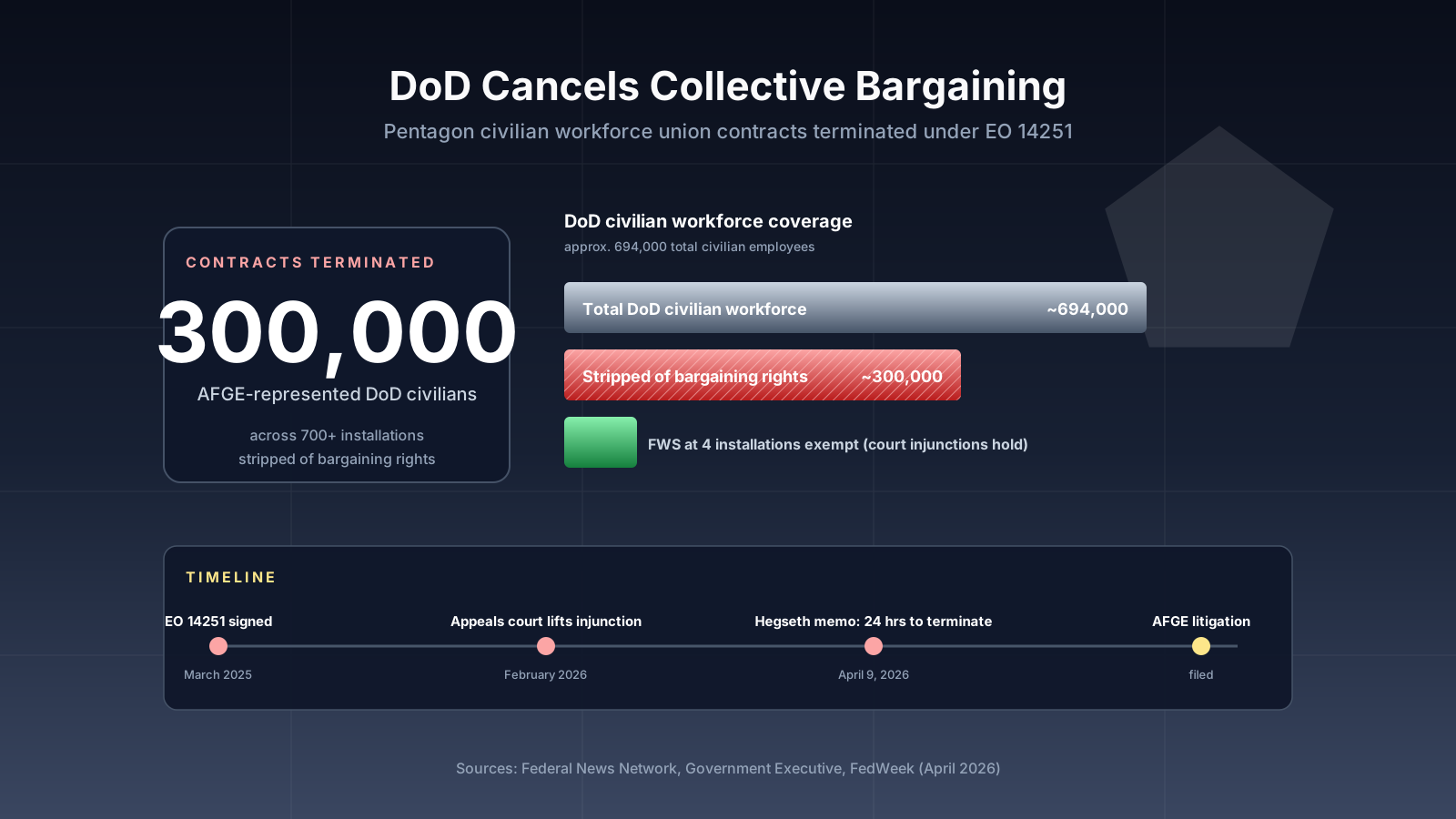
Defense Secretary Pete Hegseth signed an April 9 memo directing senior Pentagon leaders, combatant commanders, and defense agency directors to terminate most of the department's collective bargaining agreements within 24 hours. The cancellation, executed under the national-security clause of Executive Order 14251, strips union contract protections from roughly 300,000 American Federation of Government Employees-represented Defense civilians at hundreds of installations across the country — the single largest one-day reduction in federal-employee bargaining coverage in the modern era. AFGE National President Everett Kelley called the move “cowardly” and said the union will sue. For the cohort of Defense civilians already weighing whether to stay or go, the contract cancellation removes one of the structural reasons many of them stayed.
What the Memo Actually Does
According to the Federal News Network account of the memo, Hegseth ordered the “termination of all collective bargaining agreements to which the Department is a party” within 24 hours of receipt, with carve-outs for bargaining units already covered by preliminary injunctions. The directive applies to component-level commands, the military departments, and Fourth Estate defense agencies alike. Hegseth justified the action as “required to align agency operations with national security requirements as outlined in executive order 14251,” the March 2025 order that exempted national-security-related agencies from the obligation to bargain with their employees' unions.
Government Executive confirmed the scope: most AFGE locals representing rank-and-file Defense civilians were notified within hours, with unilateral changes to working conditions following on a rolling basis. FedWeek notes a narrow set of exemptions: Federal Wage System units at four specific installations, plus members of the International Federation of Professional and Technical Engineers and the Federal Education Association, both of which secured preliminary injunctions against the underlying executive order.
Stripping the contract is not reclassifying the workforce. Defense civilians who lost contract protections are still federal employees in their existing GS or FWS roles, still entitled to Title 5 civil-service due-process protections, and still covered by the EEOC process for discrimination complaints. What they lose is the negotiated grievance procedure, the contract-driven MSPB appeal language, the negotiated leave and scheduling provisions, union-steward representation in disciplinary meetings, and the labor-management consultation forums that were the day-to-day mechanism for resolving workplace issues. The structure that allows a civilian employee to push back on a supervisor without going through informal channels has just been removed.
How the Authority Got Here
The Pentagon move is the largest single application of a strategy that has been unfolding for more than a year. A federal appeals court in February 2026 stayed the district-court injunction that had blocked broader implementation of EO 14251, clearing the path for agency-by-agency rollouts. OPM followed with guidance directing agencies to proceed with terminations except where a court order specifically enjoins the agency. The IRS rescinded its agreement with the National Treasury Employees Union earlier this year. The VA pulled, restored under court order, re-terminated its AFGE contract in March, then restored it again in mid-April after a sharp judicial rebuke.
DoD's memo lands at a moment where the legal environment is unsettled but the political direction is clear: the administration intends to keep moving absent an injunction, and unions intend to keep returning to court. AFGE's lawsuit against the Pentagon will turn on the same question that has driven the rest of the EO 14251 docket — whether DoD's sweeping invocation of “national security” goes beyond the narrow exception Congress wrote into 5 U.S.C. § 7103(b)(1). Civilian payroll, accounting, and depot-maintenance workers were not what Congress had in mind when it carved out that exception, the unions argue. The administration's position is that the Secretary of Defense gets to decide what the term means inside his department.
The Immigration-Detail Issue Running Parallel
The contract cancellation is not the only Pentagon civilian-workforce decision drawing scrutiny this month. Federal News Network describes a renewed Pentagon push for Defense civilians to volunteer for 180-day details to ICE and CBP. The detail program, first rolled out in August 2025, has placed roughly 200 Defense civilians at DHS components on tasks from logistics and data entry to operational planning for raids and patrols and management of detained migrants; about 1,000 more have been added to the rotation roster.
The Pentagon classifies the assignments as voluntary, but the line between “voluntary” and “coerced volunteering” thins when supervisors are expected to encourage their personnel to participate and the immigration-enforcement environment carries unsettled questions about civil and criminal exposure for federal employees engaged in operations later challenged in court. The collective bargaining mechanism that previously provided a structured way to surface those concerns and challenge involuntary detail decisions in the negotiated grievance process is the same mechanism that just disappeared on April 9. The two decisions are technically separate. In their effect on the civilian workforce, they are not.
Who Is Affected, and Where
DoD employs approximately 694,000 civilians, with AFGE representing the largest single share. The cancellation hits hardest in workforces that have always been heavily unionized: the Army Materiel Command depots (Anniston, Tobyhanna, Letterkenny, Red River, Corpus Christi), the Air Force Sustainment Center depots (Tinker, Hill, Robins), the Navy's four public shipyards (Norfolk, Portsmouth, Pearl Harbor, Puget Sound), DLA distribution and supply centers, and the Fourth Estate agencies — DCMA, DCAA, DFAS, DTRA — that have been heavily AFGE-represented for decades.
The contract cancellation arrives at the worst possible moment for those organizations, already under simultaneous pressure from the FY27 civilian reductions, ongoing realignments, and the carryover effects of the 2025 Deferred Resignation Program. Government Executive's year-anniversary survey of Hegseth's cuts found Defense civilians describing “degraded performance” and dropping morale before the union news. The April 9 memo accelerates the trajectory; it does not change its direction.
What Defense Civilians Should Know If They Are Considering a Move
For Defense civilians weighing a private-sector move, the cancellation changes the calculation in three specific ways. The negotiated grievance procedure — a meaningful piece of the case for staying through difficult management changes — is gone, leaving informal channels and EEO complaints as the slower, lower-leverage alternatives. Remote-work and alternative-work-schedule provisions that the contract typically governed are now subject to unilateral management discretion. And the labor-management consultation forums that previously surfaced shift-bidding, overtime, and detail-assignment policy changes in advance will not exist in the same form going forward.
The skill sets concentrated in the affected workforces translate cleanly into private-sector demand. Depot maintainers and shipyard artisans — nuclear-trained welders, hydraulic-systems mechanics, aircraft sheet-metal specialists — are in chronic short supply at the major defense contractors and commercial MRO houses. DCMA contract specialists and DCAA auditors are in demand at primes building out internal-audit and compliance functions. DFAS finance staff translate to controllership roles at federal-services contractors. And the broader cohort of Defense civilian program managers, engineers, and analysts overlaps closely with what the major government services contractors recruit for.
What Employers Should Watch
Defense contractors and federal-services firms with active recruiting at the depot, shipyard, and Fourth Estate footprint should expect candidate flow to grow over the next two quarters. The cohort that stayed through the 2025 cuts because the union contract preserved the working conditions they cared about is the cohort whose stay-or-go decision just got rebalanced. Recruiting cycles targeting nuclear-shipyard talent, depot-maintenance leadership, and DCMA/DCAA mid-career staff should plan for higher applicant volume from May through September.
The litigation will run on its own clock. AFGE's suit against the Pentagon, plus existing dockets at VA, IRS, HUD, and the science agencies, will produce more motions and rulings through the summer. Past patterns suggest some terminations will be enjoined and re-terminated more than once before the underlying lawfulness of EO 14251 is resolved. Employers should not plan their recruiting around an expectation that the cancellations will be unwound; the displaced cohort and the bargaining-unit cohort are increasingly the same population.
The Bigger Picture
The April 9 memo is the latest entry in a pattern that began with the January 2025 IG firings, ran through the DOGE-era separations, the FY27 civilian pay freeze, and the FY27 IG budget cuts, and now reaches the largest civilian workforce in the federal government. The structural reasons career Defense civilians had for staying through the past sixteen months — mission, pay, benefits, contract protections — are being subtracted one by one.
For the 300,000 AFGE-represented Defense civilians named in the memo, the practical question over the next ninety days is straightforward: stay and adapt to a working environment without the negotiated structure, or move to a private-sector employer that will pay for the experience and skills the Pentagon is no longer willing to pay union-contract working conditions for. Either choice is defensible. Neither one is the choice they had on April 8.
Coming Off a DoD Civilian Career?
Build your profile on HireFiredFeds and connect with employers actively recruiting depot maintainers, shipyard artisans, contract specialists, auditors, and program managers from the Defense civilian workforce.