Cutting the Watchdogs: FY27 Budget Slashes Inspector General Offices by Up to 28%
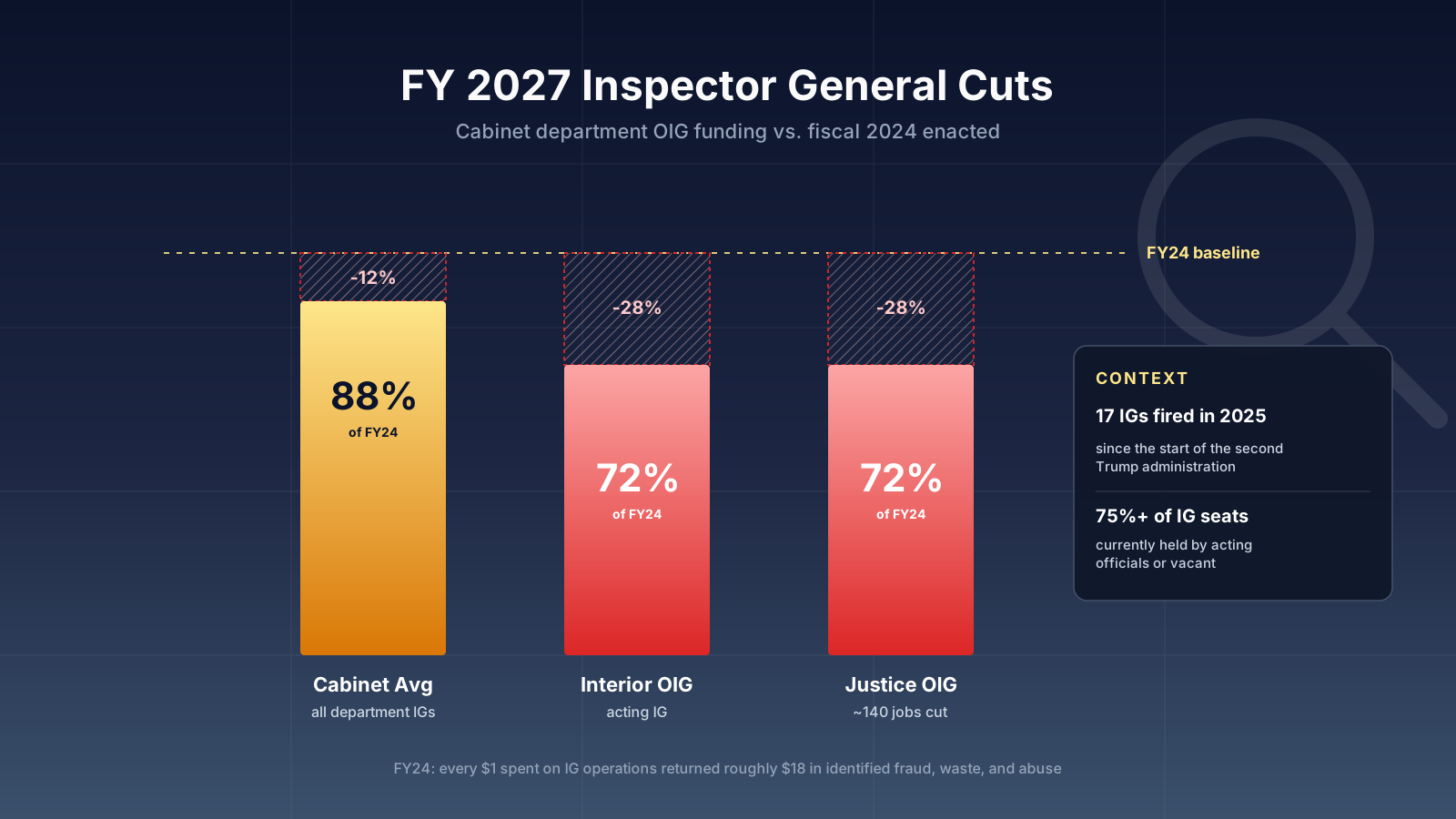
The fiscal 2027 budget request would cut Cabinet department inspectors general by an average of 12 percent compared to fiscal 2024 enacted levels, with the IG offices at the Departments of Interior and Justice each absorbing 28 percent reductions — the steepest declines in the proposal. The cuts come on top of a year in which President Trump fired 17 presidentially appointed IGs, replaced acting watchdogs at five additional agencies, and left more than 75 percent of Senate-confirmable IG seats sitting empty. For the oversight community — auditors, investigators, attorneys, and data analysts who spend their careers chasing fraud, waste, and abuse inside the federal government — the FY27 ask is the third leg of a strategy that has already reshaped the workforce.
What the Budget Actually Proposes
According to Government Executive's analysis of the proposal, the cut to Cabinet department IGs averages roughly 12 percent below fiscal 2024 levels. The deepest reductions land at Interior and Justice, both at 28 percent. The Department of Justice Office of the Inspector General alone would lose more than 140 employees, leaving the office with a workforce roughly 27 percent smaller than it was two years ago.
A separate Partnership for Public Service analysis published April 14 looked at what is happening inside the offices proposed for the steepest cuts and found a recurring pattern: the five OIGs slated for the largest dollar and staffing reductions are all currently led by acting inspectors general rather than Senate-confirmed appointees. Several already operate with staffs that are 21 to 35 percent smaller than they were two years ago. Layering further FY27 cuts on top of that diminished baseline is, as Partnership researchers put it, the recipe for “a fundamentally hampered” oversight office.
The proposed cuts are not uniform. Some IG offices that report up to agencies the administration has prioritized — including parts of the law-enforcement and immigration enforcement footprint — would see flatter funding profiles. The pattern of where the biggest reductions land is the part watchdog groups have flagged as deliberate.
A Year of Firings and Vacancies
The budget proposal arrives after fifteen months in which the IG community has been visibly hollowed out from the top. In the opening days of the second Trump administration, the White House fired more than a dozen Senate-confirmed IGs in a single round, with subsequent removals running through the year. A federal court found the firings to be in apparent violation of the Inspector General Act's 30-day notice requirement, but a separate ruling concluded that the fired watchdogs cannot be reinstated. The combined effect of the firings, additional resignations, and pre-existing vacancies is that more than three-quarters of the presidentially appointed IG positions across the federal government are now held by acting officials or are simply empty.
Mark Lee Greenblatt, who was inspector general at the Department of the Interior before he was fired in January 2025, summarized the contradiction in a statement to Government Executive: “If the goal is to fight fraud, the IGs should be getting larger budgets — not smaller.” The Project on Government Oversight reaches the same arithmetic conclusion from the data side: every dollar spent on IG operations in fiscal 2024 returned roughly $18 in identified fraud, waste, and abuse recoveries or potential savings. Cutting the offices by 12 to 28 percent does not save the proportional dollar amount; it forfeits a multiple of it on the recovery side.
Why This Hits the Federal Oversight Workforce Hard
IG offices are heavily staffed with a specific mix of professionals: GS-13 to GS-15 auditors with CPA or CIA credentials, criminal investigators (Series 1811) running fraud cases, attorneys handling administrative actions and qui tam referrals, evaluators with policy and program-analysis backgrounds, and data scientists who increasingly drive the fraud-detection work that produces the high-leverage numbers the community cites. A 28 percent cut at the Justice OIG does not fall evenly across that mix. The offices with the deepest cuts will have to choose among preserving criminal investigative capacity, preserving audit capacity, and preserving the data and analytics teams that make modern fraud detection possible. None of those choices are good.
For the cohort of IG-experienced professionals who have already left federal service over the last year — through Deferred Resignation Program offers, RIFs, or voluntary departures triggered by the leadership changes — the FY27 numbers signal what the next 18 months of the labor market will look like. The pipeline of mid-career oversight talent leaving the government is not slowing.
Where IG Talent Is Landing
Federal oversight skill sets translate cleanly into several private-sector tracks. Internal audit groups at Fortune 500 financial-services and healthcare companies actively recruit former federal auditors, particularly those with experience in complex programmatic environments — Medicare fraud at HHS OIG, defense-contracting investigations at DoD OIG, grant fraud at Education or Interior. Forensic accounting practices at the Big Four are similarly hungry for 1811-series investigators with experience working alongside U.S. Attorneys' offices.
Compliance and integrity functions at large federal contractors are another absorber. As agencies have rebuilt and as the contractor base has expanded into work the government previously did in-house, primes need staff who understand how IG investigations and audit findings actually flow. Those professionals are easier to find on the IG-alumni market in 2026 than at almost any point in the last two decades.
Mission-driven nonprofits and watchdog organizations — the Project on Government Oversight, Government Accountability Project, and similar entities — have also expanded their hiring of former federal investigators, though the headcount on that path is small relative to private-sector demand.
What This Means for Federal Contractors
Reduced IG capacity is not unambiguously good for legitimate contractors, despite the surface intuition. The IG community provides a relatively predictable, rules-based audit and investigative environment. When IG offices shrink, the locus of oversight does not disappear — it migrates. Some of the work moves to GAO, some to congressional investigative committees, and some to qui tam relators bringing False Claims Act cases on the assumption that the government's own response capacity is reduced. Contractors with disciplined compliance programs typically prefer the IG environment, where standards are documented and the process is predictable, to the qui tam environment, where the trigger is a private plaintiff.
Defense contractors should also watch the DoD IG line specifically. While DoD IG is not on the Cabinet-department list with the deepest cuts, the broader oversight ecosystem around defense contracting — DCAA, DCMA, and the various agency-level IGs — is interlocked. Significant reductions to civilian IG capacity tend to ripple through inter-agency referral patterns that defense contracting investigators rely on.
What to Watch in the Appropriations Cycle
The FY27 budget is a proposal, not a law. Several specific markers between now and the fall will determine whether the IG cuts as proposed become reality, are softened, or are reversed.
- Senate Appropriations. In the FY26 cycle, Senate appropriators restored a meaningful share of the IG cuts the administration had requested. Whether the appetite for that pushback survives a second consecutive round is the central question.
- CIGIE testimony. The Council of the Inspectors General on Integrity and Efficiency typically delivers community-wide testimony on appropriations in early summer. The testimony usually quantifies what specific cuts would mean for ongoing investigations.
- Pending nominations. The Senate has confirmed only a handful of new IGs since the start of the second Trump administration. Movement on the nomination calendar would change the leadership picture independent of the budget number.
- Litigation around IG independence. A separate Supreme Court matter on the independence of federal-employee appellate bodies could indirectly affect IG protections; watch the docket on the MSPB-related cases.
- FY27 continuing resolution scenarios. If FY27 ends up under a CR rather than enacted appropriations, the IG offices would generally be funded at FY26 levels — which would be functionally a partial reversal of the proposed cuts, but would not address the staffing problem the offices already have.
The Bigger Picture
The FY27 IG proposal is consistent with the rest of the budget: a continued reduction in civilian capacity that the administration argues is justified by efficiency claims, but which oversight veterans contend produces measurably worse return on the government's own dollar. The 10 percent civilian agency cut, the civilian pay freeze, and the IG reductions are pieces of the same picture, and the displaced cohort the federal labor market has been absorbing for fifteen months is about to be joined by another wave from the oversight community.
For employers building out federal-experienced compliance, audit, investigative, and integrity teams, the FY27 cycle is going to put more qualified former IG personnel onto the open market. The skills they bring — structured investigations, fraud analytics, federal-program literacy, and the patience required to work cases that take years — are not easily reproduced from a private-sector-only background, and the cohort displaced over the next 12 months will be the largest in a generation.
Coming from an OIG?
Build your profile on HireFiredFeds and connect with employers actively recruiting former federal auditors, investigators, and oversight professionals.