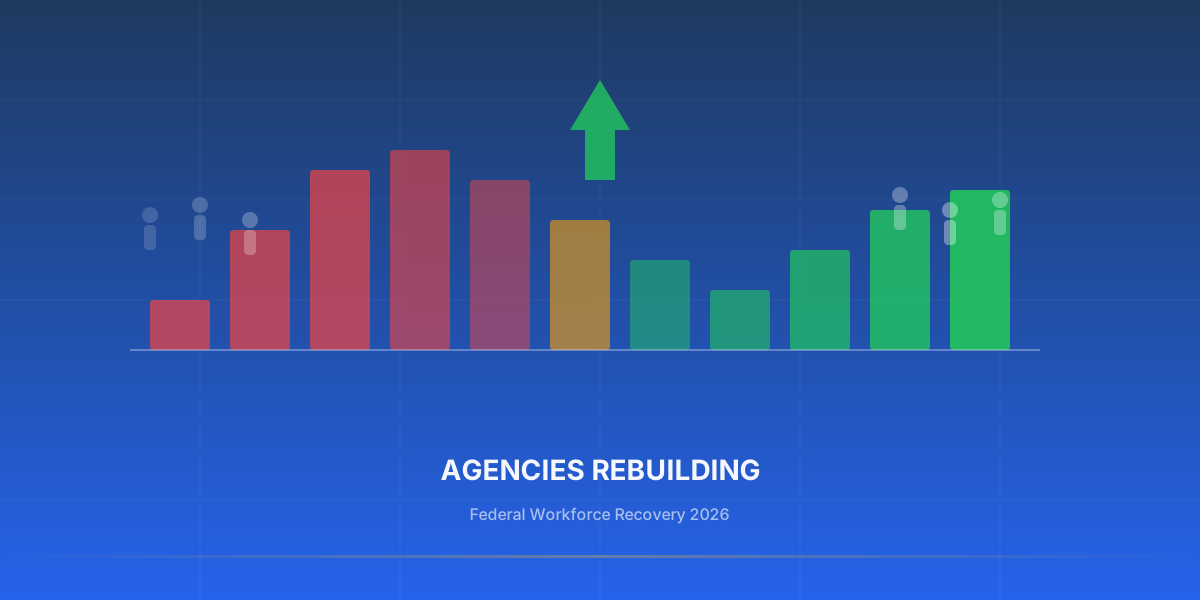
The Great Rebuilding: Federal Agencies Start Rehiring After DOGE-Era Cuts
Fifteen months after the Department of Government Efficiency began its campaign to shrink the federal workforce, a quieter movement is underway: agencies are hiring again. GSA is recruiting hundreds of employees to rebuild its gutted Public Buildings Service. The State Department is onboarding new Foreign Service officers. OPM is standing up programs to attract technologists and attorneys. The pendulum, it turns out, swings both ways.
The Scale of What Was Lost
The numbers are staggering by any measure. More than 300,000 federal employees have left government service since October 2024 — through a combination of firings, layoffs, early retirements, and the Deferred Resignation Program that paid workers to leave voluntarily. The net decrease exceeds 264,000 positions, representing roughly a 13.7% reduction in the civilian federal workforce compared to September 2024 levels.
The financial cost of the transition itself has been considerable. A recent analysis reported by Federal News Network estimated the government paid approximately $4.5 billion in salary and benefits to employees who accepted the Deferred Resignation Program but were no longer performing work. RIF-related severance payments added another $764 million between January 2025 and January 2026. The question agencies are now answering is whether the operational savings justify the institutional knowledge that walked out the door.
GSA Leads the Rebuilding Effort
The General Services Administration is the most visible example of the rebuilding trend. After losing nearly 40% of its total workforce — and at one point targeting 63% of its Public Buildings Service for elimination — the agency has reversed course. Last fall, GSA offered 400 laid-off PBS employees the chance to return to their jobs. Now the agency is hiring an additional 400 PBS employees over the next six months, as reported by Federal News Network.
The initial hiring push is focused on the areas that hurt the most: facilities management, acquisition, and project management. GSA is also recruiting early-career talent through its Acquisition Talent Development program, which is seeking 54 candidates from the recent graduate pool. The message is clear — the agency cut too deep and is now spending significant resources to get back to functional staffing levels.
The Broader Pattern: AI Plus Selective Rehiring
GSA is not alone. Across the federal government, agencies are pursuing a two-track strategy to rebuild capacity: targeted rehiring in critical functions and deploying artificial intelligence to stretch their remaining workforce further. According to Federal News Network reporting from March 2026, this hybrid approach reflects a pragmatic recognition that federal hiring is slow and agencies need interim solutions.
OPM has launched its Tech Force Program to recruit roughly 1,000 technologists into government, along with a new Attorney Talent Network for legal professionals. The State Department has been steadily onboarding Foreign Service officers — about 100 in September 2025 and 160 in January 2026. Even the Army, which forced thousands of civilian employees into a “rebalancing” process to avoid formal RIFs, is now running a cross-command matching phase to place displaced workers in new positions across installations.
What This Means for Displaced Federal Workers
If you left federal service in the past year — whether through a RIF, the Deferred Resignation Program, or a voluntary departure driven by organizational chaos — the landscape is shifting in a direction that may work in your favor. Agencies that cut aggressively are now discovering they need exactly the institutional knowledge and subject-matter expertise they let go.
That said, the federal hiring process remains slow. GSA's own leadership has acknowledged that onboarding and fully training new hires takes considerable time. If you're considering a return to government, start the application process now — don't wait for a formal announcement. USAJobs postings for rebuilding agencies are already live, and programs like Tech Force and the Acquisition Talent Development pipeline offer structured pathways back in.
For those who have already transitioned to the private sector and prefer to stay, the rehiring wave is still good news. It validates the skills you brought with you. Federal experience in acquisition, facilities management, IT modernization, and program management is demonstrably difficult to replace — which is exactly why your private-sector employer should be investing in your development and retention.
What Employers Should Watch
Private-sector employers who hired displaced federal talent over the past year should be aware that the talent pool is about to face competing demand. Agencies offering reinstatement, competitive salaries (the Tech Force Program reportedly targets $150,000–$200,000), and the appeal of public service mission may pull some workers back. Contractors and consulting firms that treated former feds as temporary labor — or that haven't matched compensation to market — may find their newest hires looking at government postings again.
The companies best positioned are those that recognized from the start that these employees bring capabilities forged in environments most private firms never encounter: managing billion-dollar portfolios, navigating the FAR, operating under congressional oversight, and delivering results in politically volatile conditions. If you invested in integrating that talent into your organization, the rehiring wave is competition you can handle. If you didn't, now is the time to start.
The Takeaway
The DOGE-era workforce reduction was the largest and fastest contraction of the federal civilian workforce in modern history. The rebuilding phase, now visibly underway, is a tacit acknowledgment that the cuts went further than many agencies could absorb. For displaced federal professionals, this creates a dual opportunity: leverage your experience in a private sector that genuinely values it, or consider returning to an agency that now understands what it lost.
Either way, the message from April 2026 is unmistakable. The people who built, managed, and maintained the federal government's operations are needed — whether the badge says .gov or .com.
Looking to Return to Government — or Stay in the Private Sector?
Build your profile on HireFiredFeds and connect with employers who value federal experience.