Trump's FY27 Budget: Another 10% Cut to the Civilian Workforce
Earlier this month, the White House released its fiscal 2027 budget request. For anyone hoping the administration would pause after last year's turbulent workforce reductions, the message in the 2027 proposal is clear: the reshaping of the federal civilian government is not finished. Non-defense agencies are being asked to absorb another 10% cut, VA health staffing would drop to roughly 184,000 positions, and several of the reorganizations Congress already rejected are back on the table.
The Topline: Defense Up, Everything Else Down
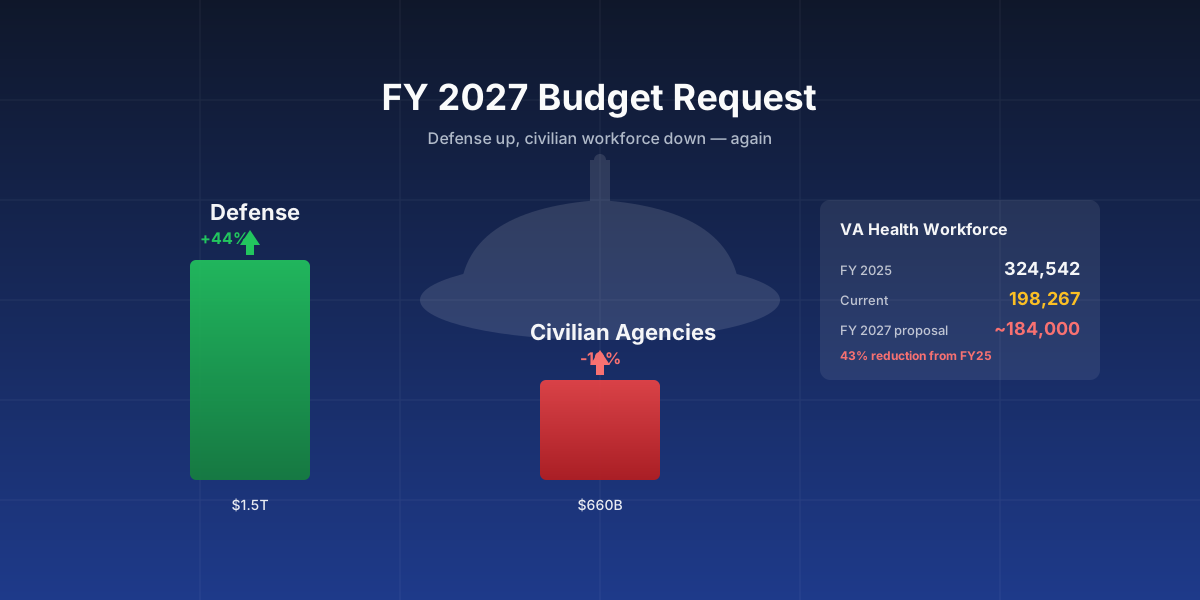
The FY 2027 request sets total discretionary spending at roughly $2.2 trillion. Defense would rise to about $1.5 trillion, a 44% increase, while non-defense discretionary spending would fall to $660 billion, a 10% cut relative to enacted FY 2026 levels. The Government Executive analysis notes that several civilian departments face cuts larger than 20%, concentrated in agencies the administration considers out of step with its priorities.
The 10% topline cut is, paradoxically, less severe than the 22% reduction the White House proposed for FY 2026 — a proposal Congress largely ignored when it finalized current-year appropriations. The administration appears to have calibrated the FY 2027 number downward in anticipation of continued congressional resistance, while still using the request to signal agency-level priorities that will drive hiring and RIF decisions through the rest of the calendar year.
The VA: A 43% Health Workforce Reduction
The single most consequential workforce figure in the proposal sits inside the Department of Veterans Affairs. According to Federal News Network's reporting on the request, VA health care staffing across three key personnel categories has already shrunk from 324,542 full-time employees in fiscal 2025 to about 198,267 employees today. The FY 2027 plan would further reduce that footprint to just over 184,000 full-time employees — a roughly 43% drop from FY 2025 levels.
The administration frames the reductions as part of the “Restructure for Impact and Sustainability Effort,” or RISE, which the White House says would streamline the Veterans Health Administration, empower local hospital directors, and eliminate duplicative layers of bureaucracy. Veterans service organizations and congressional critics have pushed back on the premise that you can shrink VA clinical staff this aggressively without affecting wait times, appointment availability, or the specialty services veterans rely on. For nurses, clinicians, and administrative staff inside the VA system, the practical implication is clear: continued hiring freezes in many roles and a continuing stream of departures through attrition and targeted RIF activity.
Agencies in the Crosshairs Again
Several reorganizations the administration pushed in 2025 are back in the FY 2027 document despite Congress having declined to enact them. The Department of Education would continue to be dismantled, with career and technical education programs moved to the Labor Department and the agency's discretionary authority cut by $2.3 billion. The Department of Homeland Security proposes merging its Office of Intelligence and Analysis, Office of the Secretary and Executive Management, Management Directorate, and Office of Situational Awareness into a single consolidated office. The Department of Agriculture is requesting $50 million specifically to execute reorganization and mandatory employee relocations.
Technology-focused agencies take notable hits as well. Government Executive reports that CISA would lose roughly $707 million, NIST would see meaningful reductions, and the IRS — already down 27% in headcount from its 2024 peak — would see further reductions on top. The National Institutes of Health faces a 15.5% cut, bringing its topline request to $41.16 billion. The Forest Service and Interior Department wildfire operations would be merged, though the White House concedes that particular consolidation requires legislation Congress has not passed.
What a Budget Request Actually Does
It is important to separate what the White House proposes from what ultimately becomes law. Budget requests are the administration's opening position in an appropriations negotiation that will run through the fall. Congress can, and frequently does, reject specific line items; last year it declined most of the reorganizations and restored funding to several agencies the administration had targeted. For federal employees, that means the most extreme numbers in the FY 2027 document are unlikely to be enacted as written.
That said, the request still shapes agency behavior in the near term. Hiring managers pay attention to the administration's stated priorities when deciding which vacancies to fill. Component heads planning fiscal year operations use the request to pace attrition and defer non-critical positions. Contractors reading the tea leaves adjust their pipelines toward the mission areas the White House is protecting. The signal matters, even when the specific dollar figures do not survive conference.
Implications for Displaced Feds and Contractors
If you are currently in one of the agencies named in the request — Education, VA health, CISA, NIST, NIH, parts of DHS or USDA — the practical guidance is the same guidance we offered last year when the FY 2026 proposal dropped: take the signal seriously without panicking. The request is a forecast of where the pressure is, not a firing notice. Update your resume. Talk to peers in neighboring agencies about lateral moves. Evaluate whether the private-sector or contractor adjacencies to your work are hiring.
For former feds already working in the private sector, the signal is different. Defense spending at $1.5 trillion, up 44%, means the prime contractors, systems integrators, and defense-tech firms will be scaling. If your federal experience was in defense, intelligence, cybersecurity, acquisition, or program management, the hiring environment for you specifically is the strongest it has been in several years. Companies in the defense industrial base and their tier-two suppliers will be competing harder for cleared and mission-literate talent through 2026 and into 2027.
The more complicated picture is in federal IT, civilian tech modernization, and health-adjacent contracting. Proposed cuts to CISA, NIST, and IRS reduce contracted work in those ecosystems, even as the administration's IT budget request remains robust in aggregate. The firms that fare best will be those with portfolio diversity across defense, civilian, and state-and-local buyers. Employees of firms concentrated on cut programs should watch for pipeline announcements in the coming quarters.
The Pattern Underneath the Numbers
Look past any single agency figure and a pattern emerges that federal workers should internalize. The administration's strategy is a three-part play: reduce civilian headcount aggressively, consolidate or eliminate agencies whose missions it considers expendable, and route savings toward a defense buildup and a select set of administration priorities. The FY 2027 request is the clearest statement yet that this strategy is not a one-time correction but an ongoing program.
For the federal workforce, that means the uncertainty of 2025 is not resolving into stability in 2026. It is resolving into a new equilibrium in which fewer people do more work in smaller agencies, with technology and AI deployed to close the gap. Whether that equilibrium is sustainable will be answered over the next several years by agency performance data, court rulings on the legality of specific reductions, and the 2026 midterm elections. In the meantime, the practical guidance for anyone in or adjacent to the federal workforce remains what it has been: plan for continued volatility, protect your optionality, and invest in the skills and networks that travel across the .gov/.com boundary.
Navigating Another Round of Federal Workforce Changes?
Build your profile on HireFiredFeds and connect with employers who value federal experience — on both sides of the defense/civilian line.