Pay Freeze Locked In: House Skips a 2027 Civilian Raise While Troops Get 5–7%
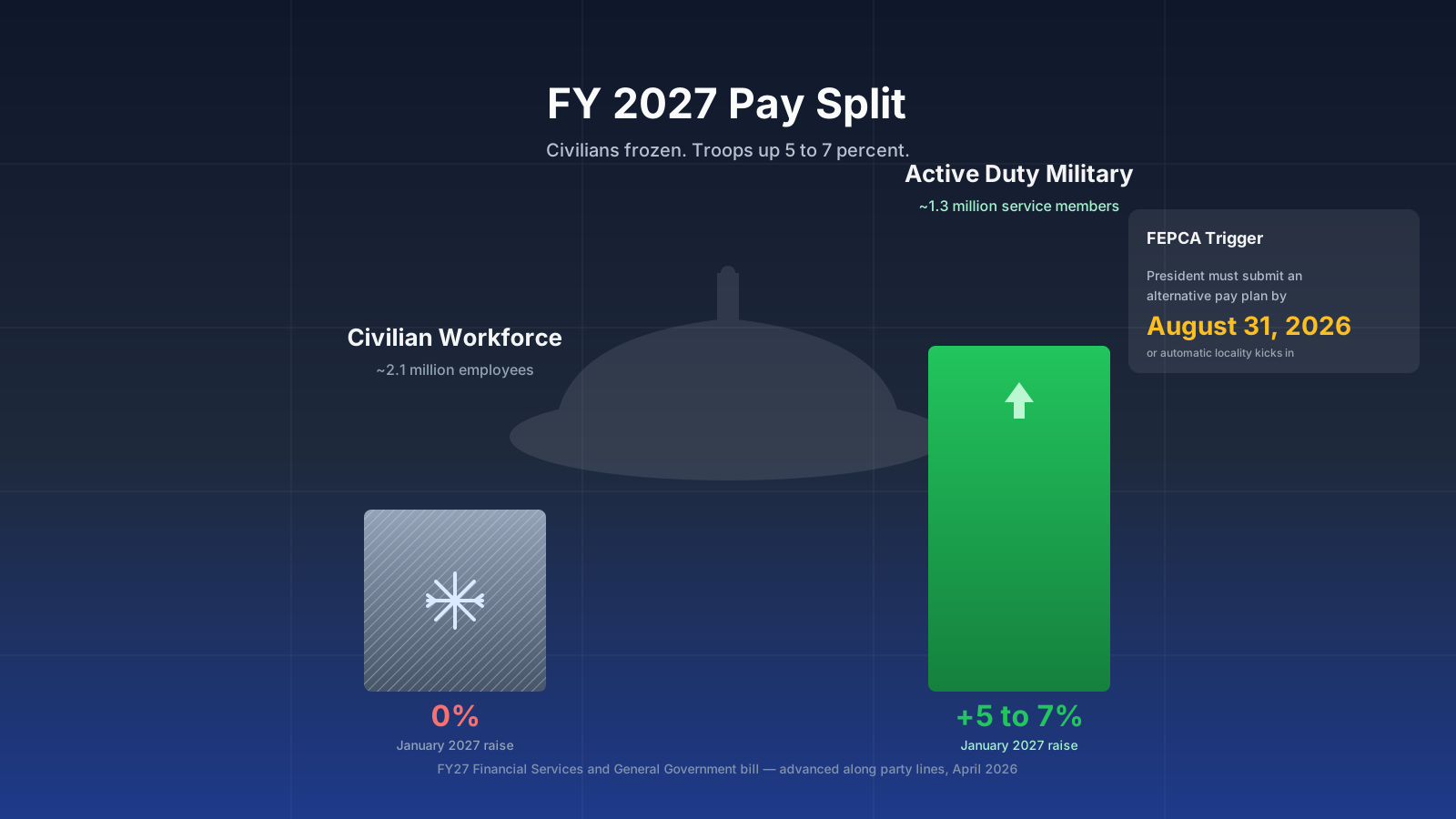
The House Appropriations Committee advanced its fiscal 2027 financial services and general government bill along party lines on April 22, and the document is conspicuous for what is missing: a civilian federal pay raise. The omission lines up with the White House's FY27 budget request, which is silent on civilian pay while proposing a 5 to 7 percent increase for active-duty military. With this week's vote, the path to a January 2027 freeze for the federal civilian workforce is no longer hypothetical — it has cleared its first major procedural step.
What Just Happened
According to Federal News Network, House appropriators released the financial services and general government (FSGG) appropriations bill for FY27 with no funding language for a civilian pay adjustment. The committee approved the measure on a party-line vote and pushed it forward in the appropriations cycle. FedWeek framed the action as the next step toward a 2027 freeze, and Government Executive noted that the silence in the bill mirrors the silence in the White House's budget request — a deliberate alignment, not an oversight.
The contrast with military pay is the part that has drawn the most attention. The same FY27 budget request proposes between a 5 and 7 percent raise for service members, with the largest increases concentrated at the lowest enlisted ranks. Defense as a whole would receive roughly $1.5 trillion under the proposal — the largest defense ask in decades — while non-defense civilian agencies absorb another 10 percent reduction.
How a Pay Freeze Actually Becomes Law
Federal civilian pay does not move automatically with the appropriations cycle. Under the 1990 Federal Employees Pay Comparability Act (FEPCA), if the president takes no action, the law triggers a substantial automatic locality adjustment intended to close the gap between federal and private-sector wages. To override that default, the president must transmit an “alternative pay plan” to Congress by August 31 of each year specifying the proposed raise — or the absence of one.
For 30 years, every president has used the alternative pay plan mechanism rather than letting FEPCA run on autopilot. The Trump administration is widely expected to do the same again this summer, formalizing the freeze for January 2027 with an alternative pay letter that proposes 0 percent. The House FSGG bill effectively front-runs that letter: by writing no raise into the spending legislation, it signals legislative consent for whatever the White House submits in August.
The Senate side is the remaining variable. In past cycles the Senate has occasionally restored a small raise that the House omitted, but the appetite for that fight is unclear in 2026 — particularly after a year in which Congress accepted most of the administration's workforce-reduction posture without significant reversal.
What a Freeze Costs in Real Money
A 0 percent civilian pay adjustment in January 2027 follows a 2 percent raise in 2026, which itself was below the 4.7 percent that FEPCA arithmetic would have produced for federal-private parity. Federal pay was already running roughly 25 percent behind comparable private-sector positions in the most recent Federal Salary Council analysis, and a freeze widens that gap by another full year of inflation.
For a GS-13 step 5 in the Washington-Baltimore locality earning around $137,000 base, a 0 percent year is roughly $4,100 in lost compensation against a 3 percent baseline expectation, and around $6,500 against the FEPCA-target raise. For lower grades the absolute dollars are smaller, but the gap to comparable private roles is larger in percentage terms — particularly in technical, cyber, and clinical specialties where private-sector pay has continued to climb.
None of this affects locality pay structure; it affects the across-the-board piece. Cost-of-living differentials between, say, San Francisco and the Rest-of-U.S. zone remain in place. What does not happen is the annual adjustment of the underlying tables.
Why the Civilian/Military Split Matters
The FY27 cycle is the third consecutive year in which civilian and military pay are diverging. Junior enlisted received a 14.5 percent targeted raise in 2025, all service members got an above-trend raise in 2026, and the FY27 proposal continues that trajectory with a 5 to 7 percent ask. Civilians, meanwhile, received a 2 percent raise in 2026 and are now staring at a freeze.
That divergence has direct workforce consequences. Many civilian positions in defense and intelligence agencies — DoD civilians, NSA, NGA, defense contracting offices — sit beside uniformed counterparts whose total compensation is moving in the opposite direction. Recruiting and retention pitches for those civilian positions become measurably harder when the colleague at the next desk just received a 7 percent raise. Agency HR offices have flagged this concern privately for two years, and the FY27 bill does not address it.
What This Means for the Displaced Federal Workforce
For the cohort that has already left federal service through Deferred Resignation Program offers, RIFs, or voluntary departures over the last 18 months, the freeze is a tactical signal more than a financial one. It reinforces what the FY27 budget already telegraphed: the federal pay table is not going to be the lever the administration uses to retain or attract talent in 2026 or 2027. Anyone debating whether to take a private-sector role at a 15 to 25 percent compensation lift should now factor in that a return path to federal service comes with no near-term raise to count on.
For the cohort still inside federal service, the freeze stacks on top of the Schedule Policy/Career reclassification and the 10 percent civilian agency cuts already in motion. The compounding effect — flat pay, weakened tenure protections, smaller agencies — is the part that comes up most often in conversations with mid-career employees weighing departures. A single freeze year is survivable; the cumulative signal is what is moving people.
For the cohort considering a return — particularly the HHS alumni weighing whether to take advantage of the agency's 12,000-hire rebuild — the freeze does not invalidate the opportunity, but it changes the math on grade and step negotiations. Coming back at the same grade after a year out, with a frozen 2027 pay table, can mean meaningfully less real income than the role would have offered in 2024.
What This Means for Federal Contractors
Contractor base rates are not directly tied to the GS schedule, but they are influenced by it. Cleared roles in particular benchmark against federal counterpart grades when government customers evaluate proposed labor categories. A frozen GS table tends to slow the rate of allowable escalation in long-running indefinite-delivery, indefinite-quantity vehicles and option-year extensions. Contractors with FY26-FY27 option years coming up should expect government customers to lean on the freeze as justification for tighter rate negotiations.
On the opposite side of the equation, the freeze is a recruiting tailwind for contractors picking up displaced federal talent. The differential between a frozen GS-13 base and a contractor offer with a 10 to 20 percent uplift becomes more visible to a candidate who can no longer count on an annual federal increase to close the gap.
What to Watch Between Now and August
- Senate FSGG mark-up. The Senate Appropriations Committee's version of the FSGG bill is the next concrete chance to restore a civilian raise. Watch for it to be marked up in early summer.
- Trump's alternative pay plan letter. Due to Congress by August 31, this is the document that formally proposes the 0 percent figure (or anything else). Historically, the letter is a one-paragraph transmittal — but the number it carries is binding absent a contradicting appropriations bill.
- Federal Salary Council recommendations. The Council typically issues recommended locality pay adjustments in late summer or fall. Those recommendations have not driven the actual raise in 30 years, but they remain the cleanest measure of how big the federal-private gap is at any given moment.
- Union pay-related actions. AFGE and NTEU have signaled they will push back through legal and legislative channels if the freeze is finalized. Whether those efforts get traction is the wildcard.
- Continuing resolution scenarios. If FY27 ends up under a CR rather than a finished appropriations bill, the alternative pay plan still controls. CRs do not automatically restore raises that were not enacted.
The Bigger Picture
For two budget cycles, the federal pay table has been quietly converging with a private-sector that has run away from it. A FY27 freeze hardens that gap rather than narrowing it. Combined with Schedule Policy/Career, smaller agency footprints, and a workforce that has already shed more than 300,000 employees since the start of 2025, the cumulative message to career federal civilians is unambiguous: the compensation case for staying inside government is weaker than it has been at any point in the last two decades.
That does not mean everyone leaves. Mission-driven federal work has always been valued at less than its private-sector substitute, and many of the people doing it know exactly why they are still there. But the math is harder to make work in 2027 than it was in 2024, and the people who have been on the fence for two years now have one more line item in the “go” column.
Weighing the move?
Build your profile on HireFiredFeds and connect with employers who actively recruit federal civilians, contractors, and veterans.