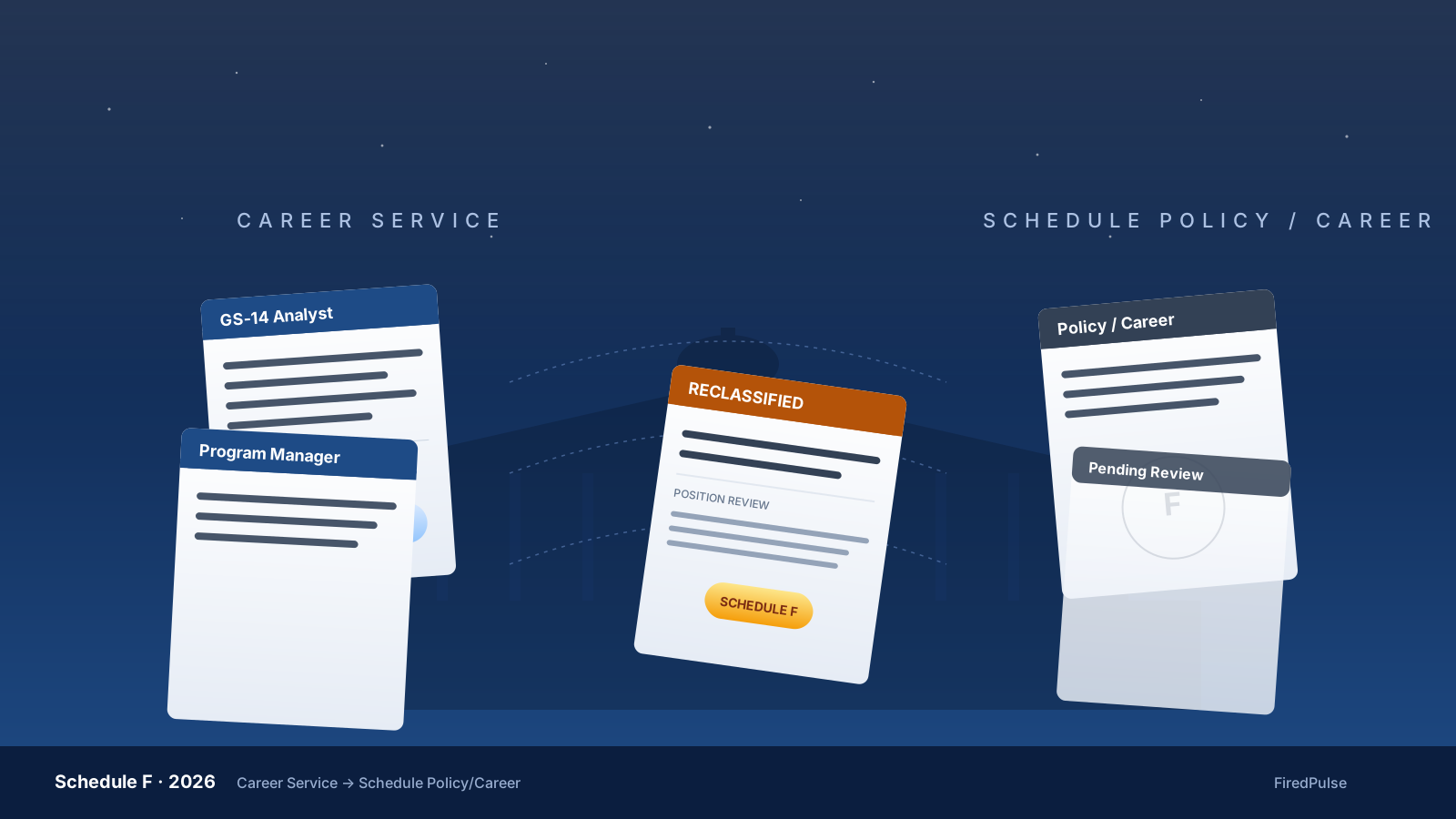
Schedule F in 2026: What Career Federal Employees Need to Know
After more than a year of regulatory churn, the reclassification of federal jobs under Schedule F — now formally the “Schedule Policy/Career” category — is moving from policy memo to personnel file. For tens of thousands of career civil servants and the contractors who work alongside them, 2026 is shaping up to be the year the ground actually shifts.
What Schedule F Actually Does
Schedule F strips away the traditional adverse-action protections that have defined the career civil service for more than a century. Employees whose positions are deemed to involve “confidential, policy-determining, policy-making, or policy-advocating” work can be reassigned into the new schedule — and, once reclassified, removed with dramatically less due process than before.
The Office of Personnel Management has directed agencies to review broad swaths of GS-13 through SES positions for potential reclassification. Early estimates from agency transition documents suggest the affected pool is larger than the initial 50,000 figure floated in 2025, with some agencies identifying entire program offices as candidates.
Who Is Most Exposed
The reclassification net is wider than many expected. It reaches well beyond traditional political roles into jobs that career employees have held for decades:
- Policy analysts and program managers at HHS, Education, EPA, Labor, and Treasury whose work touches rulemaking.
- Regulatory attorneys and economists whose analyses feed into federal register filings.
- Data scientists and IT leads supporting systems that underpin policy decisions.
- Senior technical staff in scientific agencies whose findings influence policy direction.
The through-line: if your work product can be cited in a policy decision, your position is likely under review.
The Second Wave of RIFs
Schedule F is arriving on top of a second wave of Reduction-in-Force actions rolling through Q1 and Q2 of 2026. Where the 2025 RIFs concentrated on probationary employees and discrete program eliminations, the 2026 wave is structural — whole divisions consolidated, duplicative offices merged, and layered management flattened.
For career employees, the compounding effect is the hardest part. A position may survive the RIF only to be reclassified, or survive reclassification only to be cut in the next round. Planning a multi-year career inside this environment is genuinely difficult, and many senior employees are voluntarily moving to the private sector before the decision is made for them.
What It Means for Federal Contractors
Contractors sitting next to affected government teams are feeling the turbulence directly. When a program office is reorganized or a policy shop is reclassified, task orders get paused, extended, or re-competed. Billable hours disappear overnight, and the cleared professionals filling those seats start looking for stability elsewhere.
The consulting firms and systems integrators absorbing the brunt of this are already shedding staff through quiet bench reductions. For individual contractors, this means the traditional playbook — ride out a slow quarter on bench, wait for the next task order — is no longer reliable.
Practical Steps If You're in the Affected Pool
- Get your documentation in order now. Performance reviews, SF-50s, position descriptions, and clearance paperwork should be exportable within an hour.
- Know your bump and retreat rights. If you're in a bargaining unit, your competitive area and tenure still matter for the non-Schedule F path.
- Map your skills to private-sector language. “Managed a $400M portfolio across 14 contracting officers” lands differently than “served as CO-level liaison.”
- Protect your clearance. A continuous-investigation-eligible clearance is one of your most transferable assets — don't let it lapse.
- Start the private-sector conversation early. Hiring cycles for cleared roles are long. Starting after a formal separation date puts you months behind.
What Employers Should Be Doing
For private-sector employers — particularly government contractors, consulting firms, and mission-aligned technology companies — this is the rare moment when deeply experienced, cleared, institutionally-literate talent is actively available. The candidates entering the market in 2026 include people who wrote the regulations you need to comply with, built the systems you're trying to integrate with, and managed programs at a scale most private companies never see.
The firms moving fastest are rewriting job descriptions to translate federal titles (Program Analyst, Senior Advisor, Branch Chief) into private-sector equivalents, loosening rigid “X years in industry” filters, and pulling interviews forward to close before competing offers land.
The Bigger Picture
Schedule F is not just an HR rule change — it represents a fundamental rethinking of the relationship between career expertise and political direction in the executive branch. Regardless of where you land on that debate, the practical effect in 2026 is a historically large pool of experienced public-sector professionals entering a private labor market that genuinely needs them.
For displaced feds, the advice we keep coming back to is simple: start early, tell your story in private-sector terms, and protect the credentials that took you years to build. For employers: this window won't stay open indefinitely, and the people you hire now will define your capability for the next decade.
Affected by Schedule F or the 2026 RIF Wave?
Build your profile on HireFiredFeds and connect with employers who value federal experience.