HHS's Boomerang: 12,000 New Hires at an Agency That Just Cut 20,000
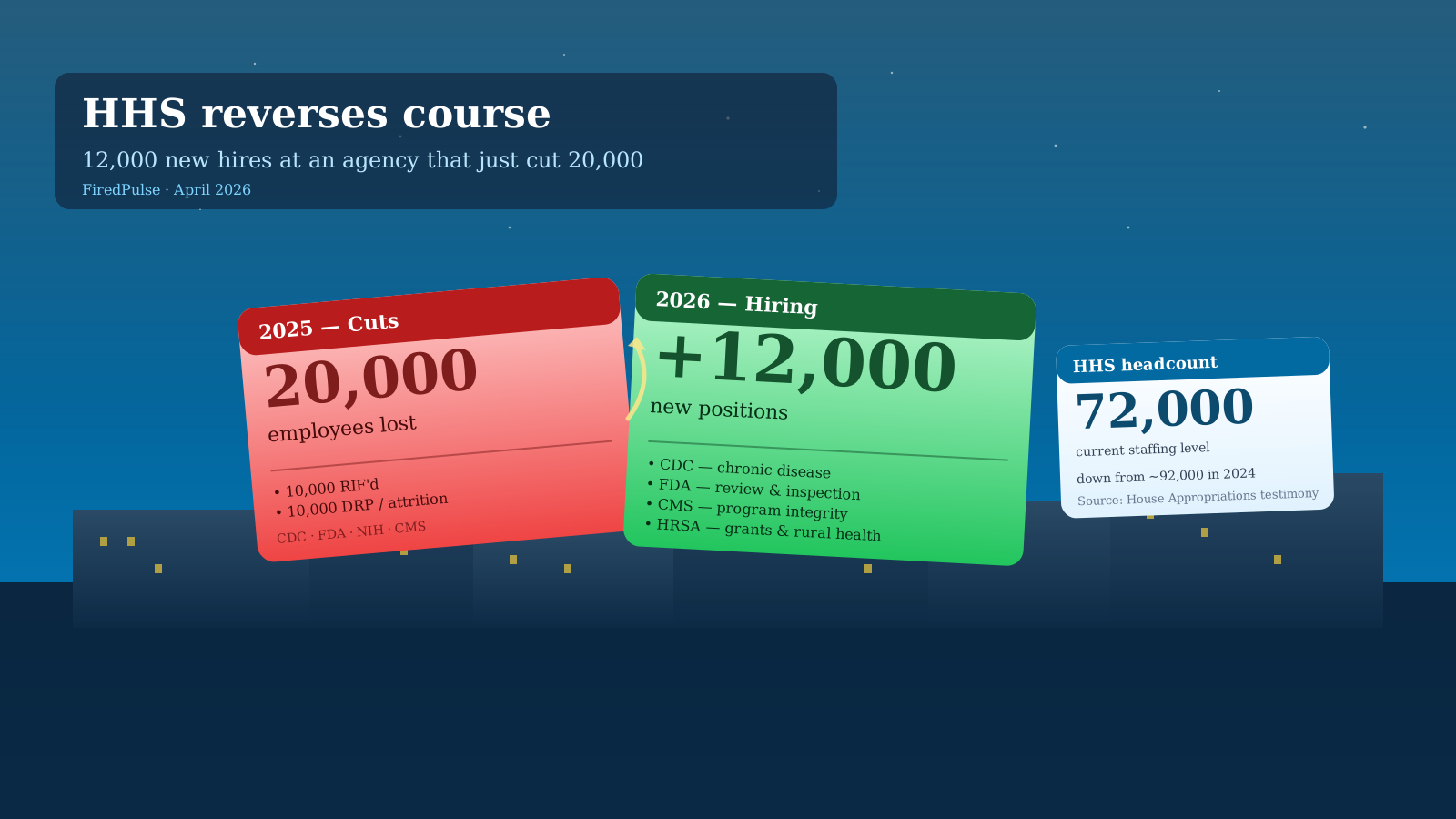
A year after the Department of Health and Human Services shed roughly 20,000 employees through reductions in force, buyouts, and attrition, Secretary Robert F. Kennedy Jr. told House appropriators this week that HHS is now hiring 12,000 new staff. The agency's headcount has stabilized at about 72,000, and leadership is openly saying the rebuild is necessary to do the work. It is the most visible reversal yet in an administration that spent 2025 defining itself by federal-workforce reductions.
What Kennedy Actually Said
According to reporting from Government Executive and Federal News Network, Kennedy appeared before the House Energy and Commerce health subcommittee on April 21 and confirmed that the department intends to bring on roughly 12,000 new employees. He framed the cuts of 2025 as a deliberate cultural reset and argued, at a parallel Senate Appropriations hearing, that service quality had not degraded during the drawdown — a claim that is contested, but that is how leadership is characterizing the internal record.
What Kennedy did not do is retract the cuts. The administration's position is that HHS is smaller, different, and now hiring back selectively — not that 2025 was a mistake. The 12,000 number is a target, not a guarantee, and it sits against a baseline that is still well below the department's pre-2025 ceiling of roughly 92,000 employees.
Where the Hires Are Actually Going
Internal communications and recent reporting point to four priority destinations for the new positions:
- CDC chronic disease operations. Acting CDC Director Jay Bhattacharya used a staff town hall on March 25 to signal that chronic disease — cancer, cardiovascular, diabetes, and injury prevention — would lead the rehiring plan, per Federal News Network. These centers were among the hardest hit in the 2025 RIF.
- FDA review and inspection staff. Reviewer headcount and field inspection capacity drove much of the 2025 cost savings on paper, and both functions have become the choke point for user-fee cycle times and import-oversight backlogs.
- CMS program integrity and policy. Medicare and Medicaid program operations carry the largest portion of HHS's dollar spend, and hiring here is the fastest way for leadership to show results on fraud, improper payments, and drug-pricing implementation.
- HRSA and workforce-facing programs. The Health Resources and Services Administration oversees community health centers, the Ryan White program, and rural health grants — all of which require on-the-ground grant management staff whom the 2025 cuts cannot easily be reconstituted from contractors.
NIH is notably quieter in the public messaging, partly because grant-making staff turn over on a different cycle and partly because the institute-by-institute reorganization from 2025 is still being adjudicated.
The Reinstatement Pattern Preceding This
The 12,000-hire target did not appear in a vacuum. HHS has been quietly reversing specific layoffs for the last ten months: the department brought back roughly a third of CDC employees RIF'd in April 2025, reinstated the entire laid-off cohort at the National Institute for Occupational Safety and Health in January 2026, and reopened a series of job postings across CMS and FDA throughout the first quarter. What changed this week is that leadership started saying the number out loud — and started signaling that the rebuild would be agency-wide rather than one reversal at a time.
For the former HHS workforce, this matters in two ways. First, anyone who was RIF'd or who took a Deferred Resignation Program offer in 2025 is eligible to be considered for reemployment, and in many cases has priority rights for two years under OPM rules on restored federal employment. Second, because the new postings are going up quickly and in concentrated functional areas, timing matters — positions at HHS tend to fill fastest when they are first opened, and the applicant pool on later postings is larger and more competitive.
Why This Is Different From the Interior Wave
We covered Interior's third-wave Deferred Resignation Program last week — an agency still actively contracting its headcount. HHS is the opposite cycle: the cuts are a year behind them, and leadership is trying to rebuild capacity at the bureaus that have the most visible downstream consequences when they are understaffed.
The contrast is useful because it reveals what the broader federal workforce cycle actually looks like in 2026: some agencies are still shrinking, some are rebuilding, and both are happening under the same political banner. That is a different reality than the “everyone is cutting” narrative that dominated 2025, and it changes the calculus for displaced feds deciding whether to stay in public service or move on.
What Former HHS Staff Should Do This Month
- Check your reemployment priority status. If you were involuntarily separated via RIF, you likely hold Career Transition Assistance Plan (CTAP) or Interagency Career Transition Assistance Plan (ICTAP) eligibility for up to one or two years. That eligibility is worth real money on a USAJobs application — confirm with HR before applying.
- Set a saved search on USAJobs.gov now. Filter for HHS, then by sub-agency (CDC, FDA, CMS, HRSA, NIH, HHS/OS). New postings in the priority functions are going up weekly, and the best ones are closing fast.
- Don't wait for a perfect backfill of your old position. Many of the new postings are restructured roles at different grade levels or with reshuffled portfolios. If the work is 70% a match, apply.
- Preserve your federal service record. SF-50s, position descriptions, and training records should be in hand before you need them. If you have left the agency, pull what you can while former colleagues are still in place to help.
- Consider a contractor bridge. FDA and CMS, in particular, have been using contractor augmentation while the direct-hire positions slowly open. A contractor role that puts you adjacent to the program can be a reasonable path back in.
What Employers Should Take From This
Not every displaced HHS professional will go back to HHS. The 12,000-hire target still implies that most of the 2025 outflow will not return to the agency — which means the private sector, non-profit public health, state and local health departments, and federal contractors doing HHS-adjacent work will continue to see experienced candidates for at least another hiring cycle. The typical HHS alumnus brings regulatory literacy, grant management experience, and a working knowledge of Medicare-Medicaid policy or FDA processes that takes years to build from the outside.
Biotech, health-tech, hospital systems, managed-care organizations, pharmacy benefit managers, clinical research organizations, and health-focused consultancies have all benefited from the 2025 outflow. The window is not closing, but it is narrowing: the candidates who were open to leaving the sector in mid-2025 are increasingly either settled in a private-sector role or are actively being pulled back to HHS. Employers that are still hiring from this pool should assume the recruiting window tightens as HHS posts more positions through the rest of the year.
The Bigger Pattern
Zoom out and this is the same story we have been writing all year: large federal agencies cannot sustainably shed a quarter of their workforce without having to buy some of it back. GSA was the first to signal a rebuild, the CDC reinstatements came next, and HHS is now the largest and most public reversal to date. The agencies watching this closely — Treasury, VA, and the Department of Education — are the ones where a similar turn would have the biggest labor-market implications.
For former HHS staff, the takeaway is simple: the door is not shut. For displaced feds elsewhere, the takeaway is that the cycle is real, and the agencies that cut first are the first ones hiring back. For employers, the takeaway is that the clock started the day Kennedy said the number out loud — and the best candidates are already rereading their old position descriptions.
Former HHS, CDC, FDA, or NIH?
Build your profile on HireFiredFeds and connect with employers who actively recruit former federal public health professionals.