Relocate or Resign: USDA Folds 1,200 Food Assistance Staff Into Reorg That Cost ERS and NIFA Half Their Workforce in 2019
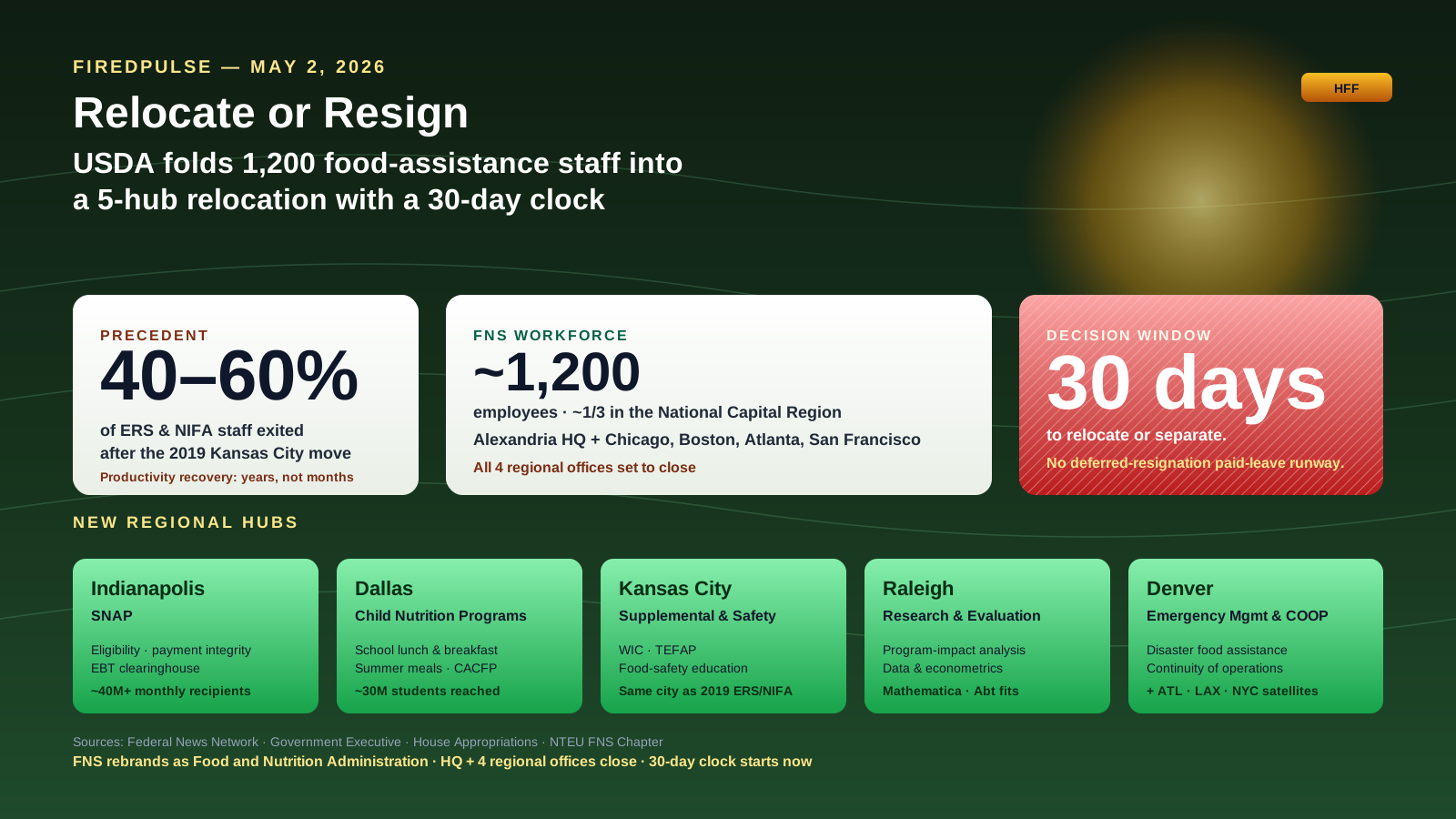
USDA confirmed this week that most of the roughly 1,200 employees of the Food and Nutrition Service will be moved out of the Washington area into a handful of regional hubs, with affected staff given thirty days to decide whether to relocate or leave. The agency is also being rebranded as the Food and Nutrition Administration. For the federal workforce that runs SNAP, WIC, and the school-meal programs, the announcement is the second large structural shift in a year — and the precedent from the 2019 relocation of the Economic Research Service and the National Institute of Food and Agriculture is that this kind of move costs an agency between forty and sixty percent of its experienced staff. The displaced cohort is concentrated in policy, program operations, IT, and benefits-eligibility analytics, and that pipeline will hit the market in two waves: a fast one in May and June, and a slower one as the hubs come online and the people who declined to move turn over to the private sector and the state agencies.
What Was Announced
According to Federal News Network, USDA folded the Food and Nutrition Service into the broader headquarters reorganization the department first laid out in mid-2025, and then formalized this spring after months of feedback from employees, lawmakers, and tribal governments. Most impacted FNS employees will move to the regional hubs USDA designated, with the agency rebranded as the Food and Nutrition Administration to mirror the new operating structure. The current Alexandria, Virginia headquarters and four regional offices in Chicago, Boston, Atlanta, and San Francisco will close, with only a small footprint left in Washington for the agency director and a limited central staff.
The hub assignments split the agency by program. SNAP administration will be based in Indianapolis. Child Nutrition Programs — the school-meal, summer-meal, and CACFP programs — relocate to Dallas. Supplemental Nutrition and Safety Programs, which house WIC and the food-safety education work, move to Kansas City, Missouri. Research and evaluation programs go to Raleigh, North Carolina. A new Denver facility absorbs Emergency Management and Continuity of Operations, with smaller satellite footprints picked up in Atlanta, Los Angeles, and New York. Government Executive's May reporting documents that roughly one-third of the 1,200 FNS employees currently live in the capital region, the bulk of them reporting into the Alexandria headquarters; for that subset, the thirty-day window forces an early decision.
The thirty-day clock is the operative number for displaced staff. Employees who decline to move will be separated, and unlike the deferred-resignation programs run elsewhere in government, this is not a paid-leave runway — it is a relocation directed reassignment. House Democrats representing the national capital region described the structure in their statement as “a mass layoff and illegal reorganization under the guise of a relocation,” arguing that the geographic spread is wide enough to function as an exit incentive for a large share of the cohort.
The 2019 Precedent
The most relevant prior data point is the 2019 USDA relocation of the Economic Research Service and the National Institute of Food and Agriculture from Washington to Kansas City. As Government Executive's reporting on the current round notes, the 2019 move cost both agencies more than half their staff in the months that followed. The post-mortem documentation, including Federal News Network's 2023 follow-up, found that the agencies eventually rebuilt headcount but with a younger, less experienced, and less diverse workforce, and that productivity recovery took years rather than months.
USDA leadership has signaled they expect a smaller refusal rate this time, on the explicit theory that the broader federal job-market collapse in the Washington area gives employees fewer outside options than in 2019. That assumption is testable. The FNS workforce skews older and more tenured than the ERS or NIFA research scientist cohorts did, and many of its members are mid-career federal benefits-program operators with deep state-agency relationships, professional licenses, and family roots in the capital region. The career economics of moving from Alexandria to Indianapolis or Dallas — accounting for spousal employment, school transitions, and house equity — are not symmetric to the 2019 case, and that asymmetry will show up in the refusal rate.
What FNS Actually Does
FNS administers the federal nutrition-assistance system. The Supplemental Nutrition Assistance Program, the Special Supplemental Nutrition Program for Women, Infants, and Children, the National School Lunch Program, the School Breakfast Program, the Summer Food Service Program, the Child and Adult Care Food Program, and the Emergency Food Assistance Program all run through FNS, with state agencies as the on-the-ground delivery partners. The federal staff sets policy, issues regulations, manages the IT systems and EBT infrastructure, runs program integrity and oversight, supports the state agencies, and handles the data and evaluation work that feeds into Congress and the White House. The agency's reach is wide — the programs collectively serve tens of millions of Americans every month.
The National Treasury Employees Union's FNS chapter, which represents agency staff, warned in a statement covered by Government Executive that without an experienced staff layer the operational continuity for SNAP, WIC, and the child-nutrition programs is at risk. The chapter's public position is that if the reorganization produces the kind of attrition the ERS and NIFA case did, “these programs simply will not function,” with downstream effects on access to food for the populations the programs serve. That is a strong claim, but it is anchored in concrete precedent: the 2019 relocations shipped a measurable productivity drop, and FNS handles a far larger operational footprint than ERS or NIFA did.
Where the Displaced Cohort Should Be Looking
The FNS pipeline is broader than the OFR or GSA pipelines this site has covered in earlier posts, because the workforce splits into several distinct skill families, each with its own private-side and state-side fits. The largest group is federal benefits-program operators — people who have spent careers running SNAP and WIC eligibility, payment integrity, and state coordination. Their highest-fit landings are state human-services agencies (every state has a SNAP and WIC operation), county social-services departments, the major Medicaid and SNAP managed-care vendors (Maximus, Conduent, Deloitte Public Sector, Accenture Federal Services), and the eligibility-systems integrators that build the case-management platforms. The second cluster is technology and data — the FNS IT staff who run the EBT clearinghouse, the program-integrity analytics, and the eligibility-system modernization work — and that group fits cleanly into Anthem/Elevance, UnitedHealth Optum, Centene, the Big Four GovTech practices, and the SaaS vendors selling into state human-services CIOs.
The third cluster is policy and research — the FNS economists and program evaluators — whose strongest fits are at Mathematica, Abt Associates, Westat, MDRC, the Urban Institute, and the food-policy programs at Brookings, the Bipartisan Policy Center, and the Food Research and Action Center. The fourth cluster, smaller but distinctive, is the field-and-emergency-management group whose work overlaps with FEMA, state emergency-management agencies, and the major disaster-response NGOs (Feeding America, World Central Kitchen, Team Rubicon). For displaced staff who are willing to relocate out of the capital region, state human-services agencies in Texas, Indiana, Missouri, North Carolina, and Colorado will absorb a meaningful share of the cohort because those are the same metropolitan areas USDA picked for the hubs.
For employers and contractors recruiting from this pipeline, the operative window is short. The thirty-day relocation decision means the first wave of refusals will hit the market in May and early June, and the people who do move will reassess later in the year as the hubs come online and the operational pain becomes visible. The contractors that already hold large state human-services or federal program-integrity contracts are the natural absorbers, and the hub cities are about to become unusually rich recruiting grounds for SNAP, WIC, and child-nutrition expertise.
The Bigger Picture
FNS sits in a different category from the watchdog and analytical shops the cut cycle has hit so far — it is an operating agency that delivers benefits to tens of millions of Americans every month, not a research or oversight office. That makes the relocation case meaningfully different from the GSA, IG, and Treasury OFR rounds. The workforce and the institutional knowledge they carry are tied to active program operations, and the disruption risk is not abstract. As Federal News Network noted in coverage of the broader USDA expansion, this is the second Trump administration that has used geographic relocation as a structural workforce tool, and the muscle memory inside USDA leadership is that the move accelerates turnover faster than a formal RIF would. Whether the 2026 version produces the 2019 attrition rate is the open question, but it is a worse question to be asking on the operations of the largest federal nutrition-assistance system in the country than it was on a research shop. For the displaced FNS staff, the practical message is the same one this site has been writing for the rest of the cycle: get the resume out, line up the state and contractor conversations now, and translate the federal vocabulary into the language the hub-city employers will recognize before the thirty-day clock closes.
FNS Alum or Federal Nutrition-Programs Pro Looking for the Next Seat?
Build your profile on HireFiredFeds and connect with employers, state agencies, and contractors that value federal program-operations experience.