Disabling the Early Warning System: Treasury's Mid-May RIF Will Cut Post-2008 Financial Watchdog OFR by 64%
Treasury's Office of Financial Research — the small Dodd-Frank office that Congress stood up after the 2008 crisis to give the Financial Stability Oversight Council its own data and risk-monitoring capability — will lose roughly 64 percent of its workforce by May 15, 2026, when the latest reduction in force is set to take effect. The cut is paired with a second deferred-resignation window that lets remaining employees collect pay through September before leaving. For roughly thirty highly specialized federal economists, data scientists, and risk analysts about to hit the private market in the next two weeks, the move closes one of the most distinctive analytic shops in the federal financial-services ecosystem. For the employers and contractors recruiting from that pipeline, the OFR cohort is one of the most translatable groups of federal talent the cut cycle has produced.
What the RIF Actually Does
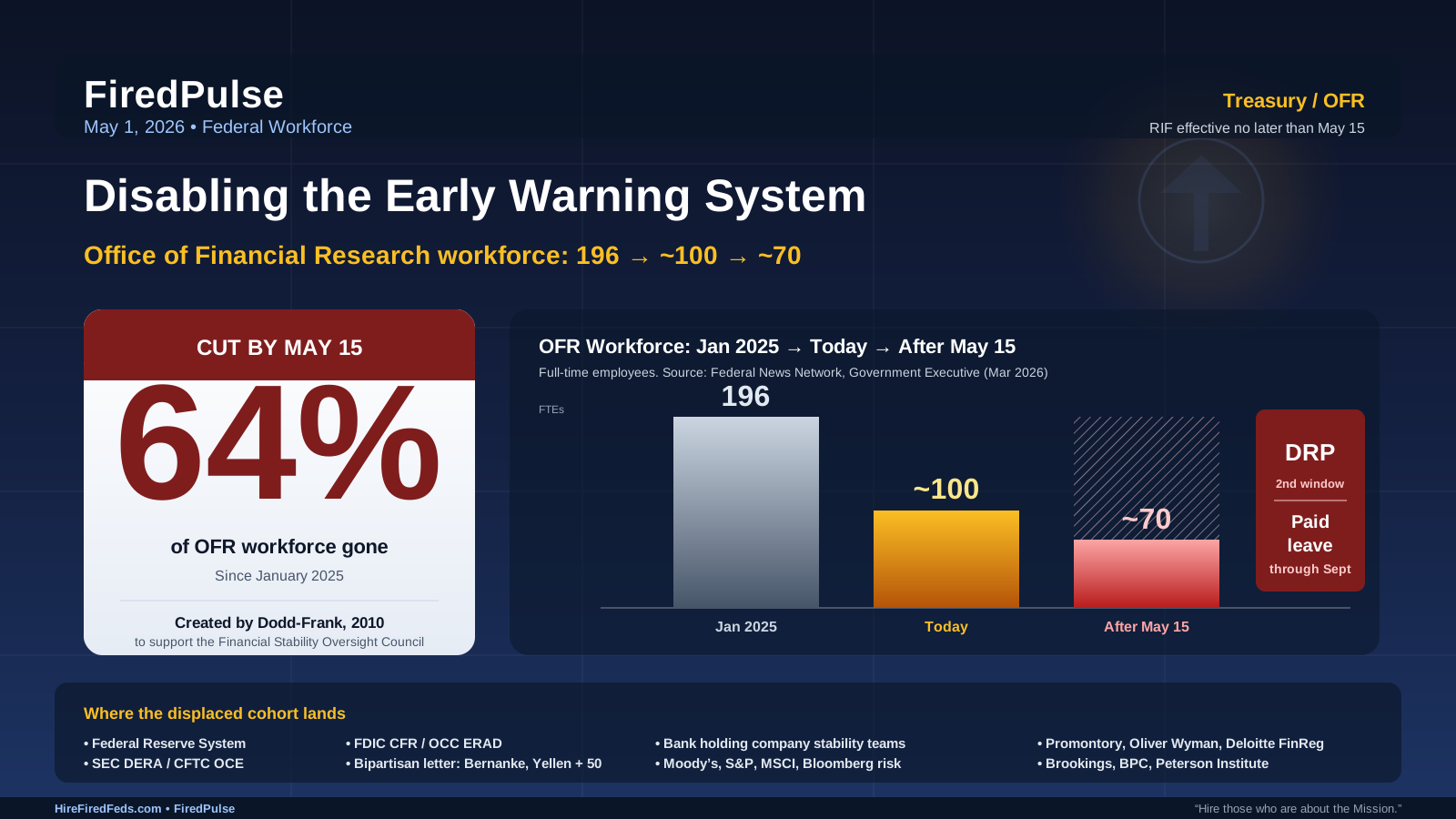
According to Federal News Network, Treasury formally notified OFR staff on March 2 that the office is “transitioning to [a] new organization structure” and that “a significant number of positions will be abolished.” In an internal email obtained by the outlet, Treasury's Associate Chief Human Capital Officer Michael Wenzler told staff that affected employees “will be placed, demoted, and/or separated” no later than May 15. Government Executive's reporting documents the trajectory: OFR began the second Trump term with 196 full-time employees, was at roughly 100 by the time the RIF notices went out, and is on track to land near 70 once the May 15 actions clear. That is a cut of roughly 64 percent in less than eighteen months.
The RIF is layered with a second voluntary exit window. Treasury offered remaining OFR employees another shot at the deferred-resignation program, under which a participant sits on paid leave through September 2026 before the formal separation date. The structure means the displaced cohort enters the private market in two waves: an involuntary one in mid-May, and a voluntary one whose members spend the summer on payroll and start interviewing in earnest closer to fall. Employers and recruiters working this pipeline should plan around both clusters, not just the immediate one.
One detail worth flagging on the budget side: OFR is funded by fees levied on large financial institutions, not by general appropriations. Cutting it does not reduce the federal deficit. Treasury's separate fiscal 2026 proposal would also trim OFR's roughly $110 million budget by about 23 percent. The combination — fewer fees collected, fewer staff retained, and a separate proposal to scale the office down to 72 FTEs in the long run — points at a structural wind-down rather than a temporary efficiency exercise.
What the Office Actually Does
OFR was created by the Dodd-Frank Act in 2010 to give the Financial Stability Oversight Council its own analytical engine — an in-house team that could pull together data across the banking, insurance, and capital-markets regulators and run risk-monitoring work that no single agency was positioned to do. As the office's own description lays out, it operates through a Data Center, a Research and Analysis Center, a Technology Center, an Operations Division, and an Office of the Chief Counsel. The Research and Analysis Center assesses risks to financial stability based on ongoing monitoring of the financial system, looking across the entire system to identify vulnerabilities that can originate, amplify, or transmit shocks.
In practice, OFR's outputs include an annual financial stability report to Congress, working papers on emerging market risks, the public Financial Stress Index, hedge fund and money market fund monitoring datasets, and ad hoc support work for FSOC during stress events. The office is small, but the work it produces is distinctive: it sits at the intersection of macro-financial data, regulatory expertise, and quantitative risk modeling that few other federal shops handle in one place.
The Bipartisan Warning
The cut is not landing without pushback. As American Banker reported, more than fifty bipartisan financial experts — including former Federal Reserve Chairs Ben Bernanke and Janet Yellen — signed an open letter warning that effectively eliminating OFR and weakening FSOC “would have devastating effects for the financial system.” The letter argues that financial crises have high socio-economic costs, that recovery from them tends to be protracted, and that defunding or significantly downsizing OFR's data and analytics capability is a particularly poor bet given today's elevated macro-financial uncertainties. The signatories are not making a partisan case for the office's headcount; they are making a continuity-of-monitoring case that landed across both sides of the aisle.
The political read is that OFR's statutory mandate makes it difficult to eliminate outright, but a 64 percent staff cut combined with a budget reduction and a publication slowdown produces a similar functional result. The remaining roughly seventy employees inherit the same Dodd-Frank obligations with substantially less capacity, and the office's public outputs are likely to thin out across the rest of 2026.
Where the Displaced OFR Cohort Should Be Looking
The OFR pipeline is unusually translatable. The displaced cohort is concentrated in five overlapping skill families — macro-financial economics, supervisory data analytics, securities and derivatives data engineering, financial-stability research, and quantitative risk modeling — and each of those families has well-defined private-market and other-federal homes already hiring.
On the federal side, the most natural landing pads are the Federal Reserve System (the Board's Financial Stability Division and the twelve Reserve Bank research departments, particularly New York, Boston, and Chicago), the Securities and Exchange Commission's Division of Economic and Risk Analysis, the Commodity Futures Trading Commission's Office of the Chief Economist, the Federal Deposit Insurance Corporation's Center for Financial Research, and the Office of the Comptroller of the Currency's Enterprise Risk Analysis Division. Each of these shops does work that overlaps significantly with OFR's portfolio, and several have continued to hire through the broader workforce cut cycle. The OFR cohort's clearance status and FSOC institutional knowledge are direct value-adds.
On the private side, the most direct fits are the financial-stability and capital-planning teams inside large bank holding companies and major asset managers, risk-modeling vendors (Moody's Analytics, S&P Global, MSCI, Bloomberg), regulatory-consulting practices (Promontory, Oliver Wyman, Deloitte and PwC's financial regulation groups), and policy think tanks doing financial-stability work (Brookings, the Bipartisan Policy Center, the Peterson Institute, the Volcker Alliance). For the more academically inclined members of the cohort, research positions at the Bank for International Settlements, the IMF, the ECB, and U.S. university finance departments recruit on the credentials OFR economists carry.
What It Means for Federal Financial-Services Talent
The OFR cut is the most concentrated reduction in a single specialized federal shop in the cut cycle so far. Treasury's separate dismantlement of other offices — captured in Government Executive's 2025 reporting — created a broader Treasury alumni pool, and the OFR group plugs into the same network. For displaced staff, the practical to-do list is short: get the resume into the federal financial regulator pipeline before the May 15 effective date, keep the deferred-resignation summer for serious private-side interviews if that exit was elected, and translate the Dodd-Frank language on the resume into the macro-prudential, capital-planning, and CCAR vocabulary the bank employers will recognize. Federal Reserve postings are the highest-probability federal landing; bank holding company financial-stability teams are the highest-velocity private-side landing.
For employers and contractors, the OFR alumni are one of the most narrowly translatable groups displaced this cycle. Anyone hiring for financial-stability research, supervisory data work, model risk management, or quantitative regulatory analytics should be watching the May–September window closely. The pipeline does not get larger from here, and the next cohort to leave will not arrive at this scale again.
The Bigger Picture
OFR is the latest small-but-strategic federal shop the cut cycle has shrunk past its operating threshold — alongside the inspectors general, the workforce-classification team at OPM, and the Public Buildings Service inside GSA. The pattern is consistent: the cuts hit hardest where the marginal employee was doing distinctive analytical or oversight work that does not have an obvious automation substitute, and the rebuild conversations have been slowest to arrive in those same shops. For the displaced cohort, that asymmetry is the news: the work is not coming back inside the federal perimeter, and the private-sector and academic homes have time to absorb the talent if the connection is made before the September runway closes. For the firms recruiting, this is one of the cleanest, most credentialed federal pipelines the cut cycle has produced. The early-warning system is being disabled inside Treasury. The people who built it are about to be available.
OFR Alum or Federal Financial-Stability Pro Looking for the Next Seat?
Build your profile on HireFiredFeds and connect with employers who value federal financial-services experience.