OPM Begins Sweeping Overhaul of Federal Job Classifications: 5,000 Feds Reassigned in First Wave
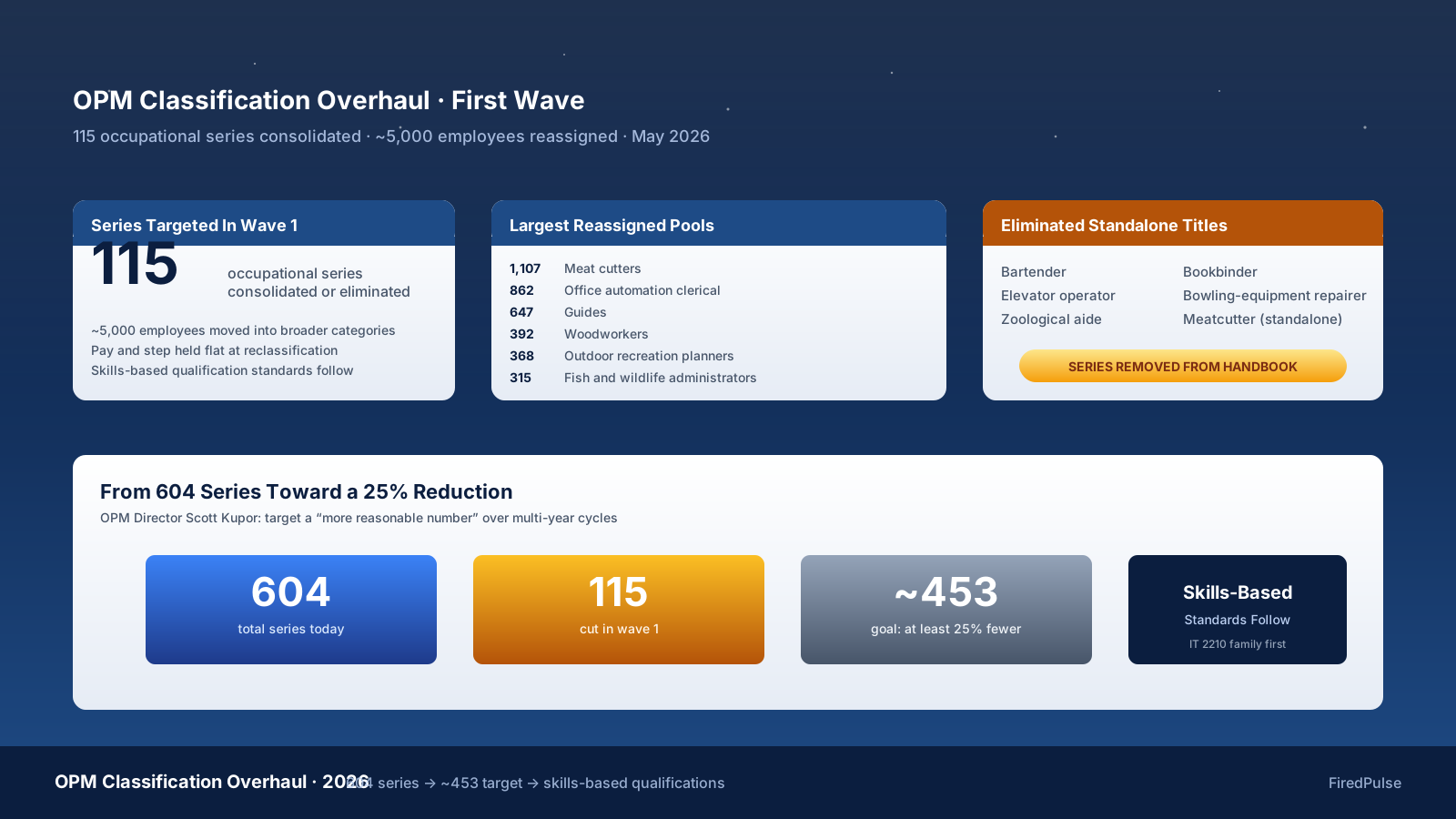
The Office of Personnel Management is opening the first wave of a structural overhaul of the federal classification system, consolidating or eliminating 115 occupational series and reassigning roughly 5,000 employees into new categories beginning in May 2026. The action is the first concrete cut at OPM Director Scott Kupor's stated goal of reducing the government's 604 job series by at least 25 percent and migrating the federal hiring system from credential-based gatekeeping to a skills-based model. For feds still on the rolls, displaced feds returning to the market, and contractors recruiting from the displaced cohort, the shift changes which titles are even available to apply to and how qualifications get scored.
What the First Wave Actually Does
According to Government Executive's reporting on the announcement, OPM identified 115 occupational series for elimination or consolidation in this first round. Every targeted series will either be folded into a broader category or removed entirely from the classification handbook. Affected employees keep their pay and their day-to-day work; what changes is the title on the position description and the family of qualification standards that governs future hiring into the role.
Federal News Network's coverage lists the largest pools of reassigned employees: 1,107 meat cutters, 862 employees in “office automation clerical and assistance,” 647 guides, 392 woodworkers, 368 outdoor recreation planners, and 315 fish and wildlife administrators. Other titles on the elimination list are smaller in headcount but conceptually striking — bartenders, bookbinders, elevator operators, and bowling-equipment repairers all disappear as standalone series. The selection criteria, OPM said, were series with fewer than 100 employees governmentwide, declining hiring activity over the last several years, non-transferable skill sets, or substantial overlap with an existing broader category.
FedWeek framed the announcement as the opening move in a much larger restructuring. OPM has indicated it will revisit all 604 federal occupational series over the coming budget cycles, with the explicit target of cutting the total count by 25 percent or more. Director Kupor told reporters the agency wants to land at a “more reasonable number” — language that, paired with the FY27 budget request and the parallel HR shared-service rollout, signals a multi-year program rather than a one-time cleanup.
The Skills-Based Pivot
The series consolidation is moving in lockstep with a broader OPM push toward skills-based qualifications. Earlier this month the agency released revised qualification standards for federal IT management positions that drop the four-year-degree requirement in favor of demonstrated experience and certifications. The same memo signals similar revisions are coming for additional 2210-family roles and for several program-management series.
Inside the federal hiring process, the practical effect is that the qualification screen — the first cut applied to USAJobs applications by an HR specialist — is moving from a credential checkbox to a self-assessment of competencies plus structured experience review. The standards do not yet apply uniformly across all series, but the IT classification rewrite is the template OPM is exporting to the next batch.
For displaced feds whose private-sector experience now substantially exceeds the era of their last federal hire, the change is the first OPM action in a decade that genuinely opens the door to crediting that experience without an artificial degree filter. For private-sector applicants who do not have a federal background, it lowers the entry barrier into the agencies that are still hiring — Social Security, the Veterans Affairs medical workforce, and parts of the rebuilt CDC chronic-disease workforce being the largest current absorbers.
Where the Cuts Land Along Career Lines
The headline reaction is that several of the eliminated titles are colorful — the bowling-repair line and the bartenders are the ones that traveled in the press cycle. The substance of the move, however, is the consolidation of the larger series. The 1,107 meat cutters and 862 office automation employees represent jobs that have been squeezed by a generation of food-service contracting and desktop computing; OPM is acknowledging on the books what already happened in practice. The 647 guides and 368 outdoor recreation planners reflect the steady contracting-out of interpretive and program-management work at land-management agencies.
The classification handbook does not, however, eliminate the underlying mission work. A consolidated series typically means the affected employee gets reassigned into a broader title — for example, an outdoor recreation planner moving into a more general “recreation and natural resource specialist” family, or a guide moving into a park-ranger or interpretive-specialist series. Pay and step do not move at the moment of reclassification, but the reference qualification standard the employee will be measured against in the next promotion or RIF cycle is different.
What It Means for Displaced Feds
For the cohort of federal employees displaced by the 2025 reductions and now in private-sector job searches, three implications are worth tracking. First, several niche federal titles that were already a hard sell in the private market — bookbinder, elevator operator, bowling-equipment repairer — are no longer a federal title at all. Anyone who held one of those titles needs to rewrite the resume around the broader functional category that absorbed it. Second, the skills-based qualification pivot weakens the “you don't have a degree, so you can't come back” barrier that has historically blocked technically capable veterans and feds from re-entering federal service in the IT and project-management families. The new standards recognize certifications and demonstrated experience in ways the old ones did not. Third, the series consolidation is signal data about which mission areas the federal government still considers core. Series being absorbed into broader categories are still functionally there; series being eliminated entirely are areas the government has decided to exit, and the contractors and non-profits that pick up that mission work are the ones doing the hiring.
What It Means for Contractors and Employers
Government contractors and consulting firms recruiting from the displaced cohort should re-tune intake screens that key on federal job titles. A candidate whose recent SF-50 reads “Outdoor Recreation Planner, GS-0023” in May will, by July, be a “Recreation Specialist” or whatever consolidated label OPM lands on. The actual experience and skill set is unchanged; the title-to-keyword match in your applicant-tracking system is not. Recruiting teams that built filters off the old series codes will start missing qualified candidates unless those filters get updated against OPM's consolidation map.
For mission-aligned non-profits — Team Rubicon, Code for America, IAVA, Tech for America — the eliminated and consolidated series list is also a roster of capability the federal government has decided not to hold internally. Programs that pick up land-management interpretation, civic-tech support, and veterans-focused service work will have a larger pool of applicants with directly relevant experience over the next several months.
The Bigger Picture
The 115-series first wave is small relative to the long-term plan, but the direction it sets matters. OPM is moving from a classification system organized around historical occupations toward one organized around current skills and competencies, and is doing so in tandem with a parallel push to drop credential filters and stand up shared HR services across agencies. Each of those moves is defensible on its own terms; together they reshape how a federal career starts, progresses, and ends. For the displaced fed cohort that defines the HireFiredFeds audience, the practical work over the next few months is straightforward: figure out which consolidated series your prior title now lives under, update your resume language to match, and use the skills-based qualification standards to your advantage when applying to either federal or private-sector roles. The hiring filter is changing in your favor. Use it.
Reclassified, RIF'd, or Restarting?
Build your profile on HireFiredFeds and connect with employers who value federal experience.