The IRS After Tax Day 2026: “Less People, Better Results” — and Another 4,000 Jobs on the Chopping Block
One week after the April 15 filing deadline, the IRS is doing a victory lap. Leadership says the agency hit its filing-season goals despite shedding more than a quarter of its workforce in twelve months. The watchdog reports, the phone-line metrics, and the FY27 budget request that just landed on the Hill all tell a more complicated story — one that points to another wave of experienced tax professionals heading for the exits.
What Just Happened at the IRS
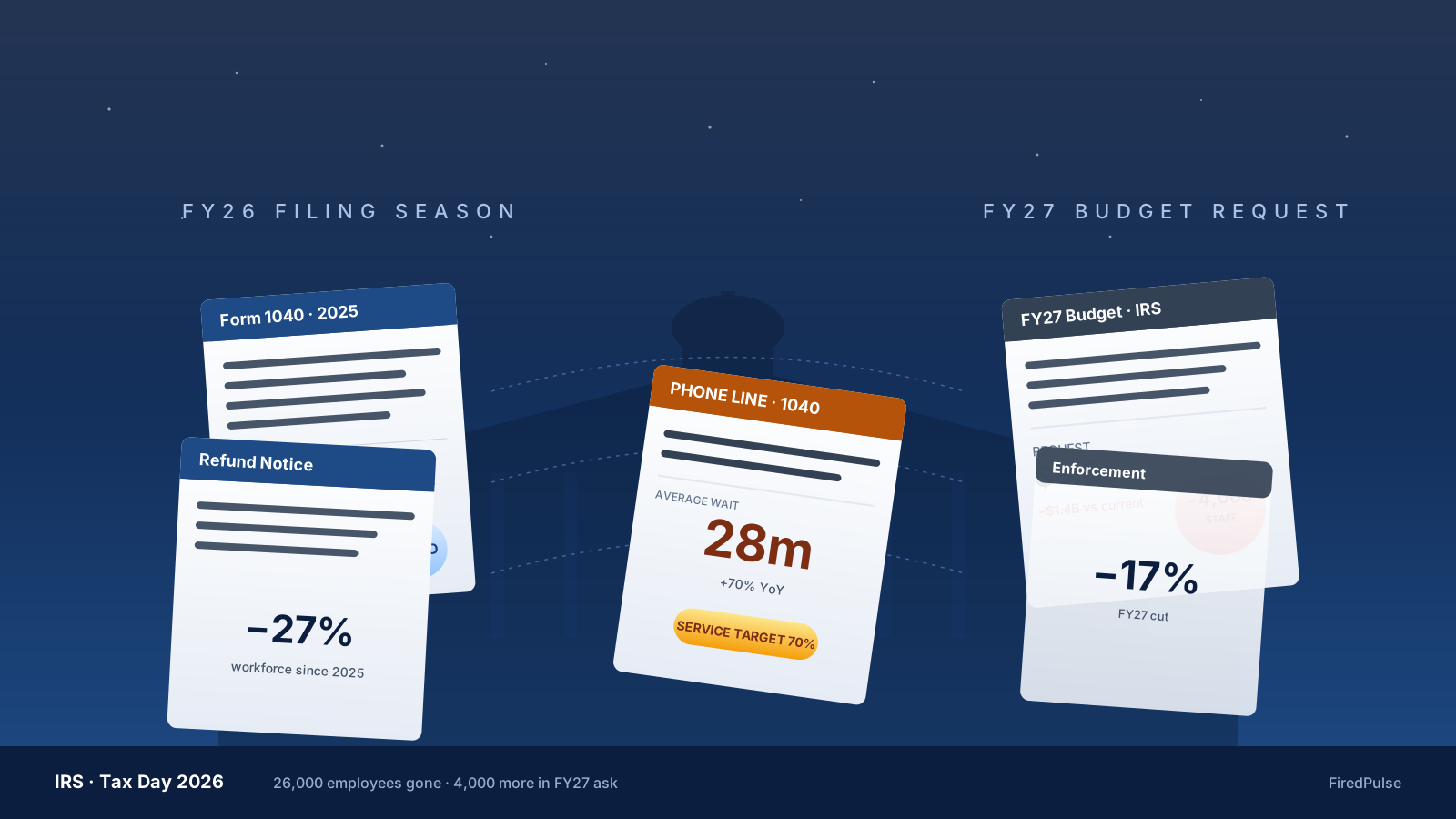
Per Federal News Network and Government Executive, the IRS lost roughly 27% of its workforce in the run-up to the 2026 filing season — more than 26,000 employees in total, mostly through the Treasury-administered deferred resignation and voluntary separation programs that have rolled across the federal government over the last year. The cuts hit some divisions harder than others. IT lost about 27% of its staff and roughly 80% of its tech leadership. Taxpayer Services shed about 22% of its headcount. Enforcement was carved more deeply still, with Treasury planning to reduce that workforce by up to 50% over the FY27 cycle.
Despite all that, agency leadership says the basics held. Returns were processed. Refunds went out. The IRS commissioner’s framing — “less people and better results” — is now being used as the in-house argument for the second-round cuts proposed in the President’s FY27 budget.
The Numbers the Watchdog Saw
The Treasury Inspector General for Tax Administration (TIGTA) and the Taxpayer Advocate Service have been less generous in their reading. Phone wait times on the IRS’s main 1040 line jumped more than 70% between February 2025 and February 2026, with average wait climbing to roughly 28 minutes. The agency quietly lowered its level-of-service phone target from 85% to 70% before the season started — a metric reset that makes any “goal met” claim a bit more elastic.
The submission-processing division, which handles original and amended paper returns, hired only about 50 of the roughly 2,500 seasonal employees it was authorized to bring on. Meanwhile, IRS managers reportedly told TIGTA they expect to lose another 1,850 processing employees through the deferred resignation program. The agency’s own internal forecasts assume those losses will lengthen processing cycles in the back half of 2026 — the period when amended returns, business filings, and IRS notice responses pile up.
On the IT side, GAO warned in March that the IRS pushed out exactly the people whose expertise is required to deploy the AI and automation the agency is now banking on. That gap matters: the FY27 plan asks Congress to accept lower headcount on the assumption that technology can fill the difference. GAO’s point, in plain English, is that the agency may have under-resourced the build-out before it started.
The FY27 Budget — Another 4,000 Out
The administration’s FY27 budget request for the IRS, summarized by Nextgov/FCW, calls for a $9.8 billion topline — a $1.4 billion cut from current spending — and a net reduction of nearly 4,000 staff on top of the 26,000 already gone. Enforcement takes another 17% reduction. The justification document leans on AI-assisted exam selection, expanded automated correspondence, and expansion of the digital intake stack to compensate.
On Capitol Hill, the politics are split. House Republicans have separately proposed a billion-dollar appropriations cut to the IRS that runs alongside the budget request. Senate Finance Democrats have flagged the math: the IRS’s own actuarial work on the Inflation Reduction Act enforcement build-up estimated each enforcement employee returns several multiples of their salary in collections, so cuts in that division show up later as forgone revenue rather than savings. Either way, the FY27 hiring and staffing posture is functionally a continuation of the cuts, not a stabilization year.
Who Is Actually Leaving
The composition of the exit cohort matters more than the headline number. The IRS skews older than most federal agencies, and the deferred-resignation programs have been most attractive to mid- and late-career employees who already had retirement on the horizon. The bulk of the 26,000 departures fall into a few clusters: enrolled agents and revenue agents in Large Business & International and Small Business/Self-Employed, IT staff in the Modernized e-File and Enterprise Case Management programs, customer-service representatives in Taxpayer Services, and a meaningful slice of senior managers across Field Collection and Field Examination.
The 1,850 processing-side departures still queued for separation will close out their work in the next several months. Combined with the FY27 ask, the realistic outlook is that another 4,000–6,000 IRS professionals will be on the open market between now and the end of next fiscal year.
Where This Talent Goes
The private-sector destinations for this cohort are well-trodden. Big Four and mid-tier accounting firms have historically absorbed revenue agents into their tax controversy and transfer pricing practices. Boutique federal tax controversy firms — many of them founded by former IRS Office of Chief Counsel attorneys — actively recruit out of LB&I. Fintechs and tax-software companies (Intuit, H&R Block, April, Column Tax) are the obvious landing spot for IT, data, and product staff with IRS modernization experience. Government contractors with Treasury-side practices — Booz Allen, Deloitte GPS, Guidehouse, MITRE, IBM Federal — recruit the program-management, acquisition, and data-engineering roles directly.
The less obvious destinations are often the better-fit ones. State revenue departments are quietly rebuilding their multistate-audit and enforcement capacity. Crypto and digital-asset compliance teams need IRS-trained eyes on John Doe summons and Section 6045 reporting. Professional services firms that serve high-net-worth families have a structural shortage of senior tax-controversy professionals.
If You’re Leaving the IRS — Practical Steps
- Translate “case” into “engagement.” A revenue agent who closed a $40M LB&I exam is a private-sector tax controversy lead in everything but title. Rewrite your bullets in the language hiring managers use.
- Lock down credentials early. Enrolled Agent status, CPE records, EA renewals, and any Section 6103-related training records should be downloaded before your access is revoked. The same goes for IT staff with vendor certifications earned on the agency’s dime.
- Don’t under-price yourself. The market rate for an experienced revenue agent in the private sector is typically 1.5–2x federal salary at the same grade. Talk to a recruiter who has placed former IRS staff before pricing an offer.
- Mind the post-employment rules. 18 U.S.C. § 207 and related ethics rules limit what you can do for clients with matters you personally worked on at the agency. Get an ethics opinion in writing before you accept anything that looks even adjacent.
- Consider a contract bridge. Several large firms hire ex-IRS staff on six- to twelve-month contracts before converting to permanent. It’s a clean way to test fit without burning your runway.
For Employers Recruiting from This Cohort
The window opens now. Most of the recently-departed and DRP-pending staff will be on a structured paid-leave runway through the summer, which means they have time to interview, talk to multiple firms, and make a deliberate choice. Firms that wait until Q4 to hire from this group will be looking at the candidates who didn’t get picked up first. Three things tend to separate the firms that win these candidates: position descriptions written in IRS taxonomy (LB&I, SB/SE, TE/GE, W&I) rather than generic “tax manager” language; flexibility on remote work, since a meaningful share of the workforce is dispersed and tied to non-DC metros; and clearance-aware recruiting for the Criminal Investigation and IT-security alumni who carry transferable Public Trust or higher.
The Bigger Picture
The IRS story is, in miniature, the federal-workforce story of 2026: a leadership claim that lower headcount is producing equal or better outcomes, a watchdog ledger that says the cracks are visible if you look at the right metrics, and a budget request that locks the smaller footprint in. Whether that holds depends on how the back half of the year goes — amended returns, notices, and the IT modernization that the FY27 plan is staked on. For the experienced tax professionals on their way out the door, the more useful frame is simpler: this is the largest single-cohort release of trained federal tax talent in decades, and the firms paying attention are already moving.
Leaving the IRS this year?
Build your profile on HireFiredFeds and connect with employers who actively recruit former federal tax professionals.