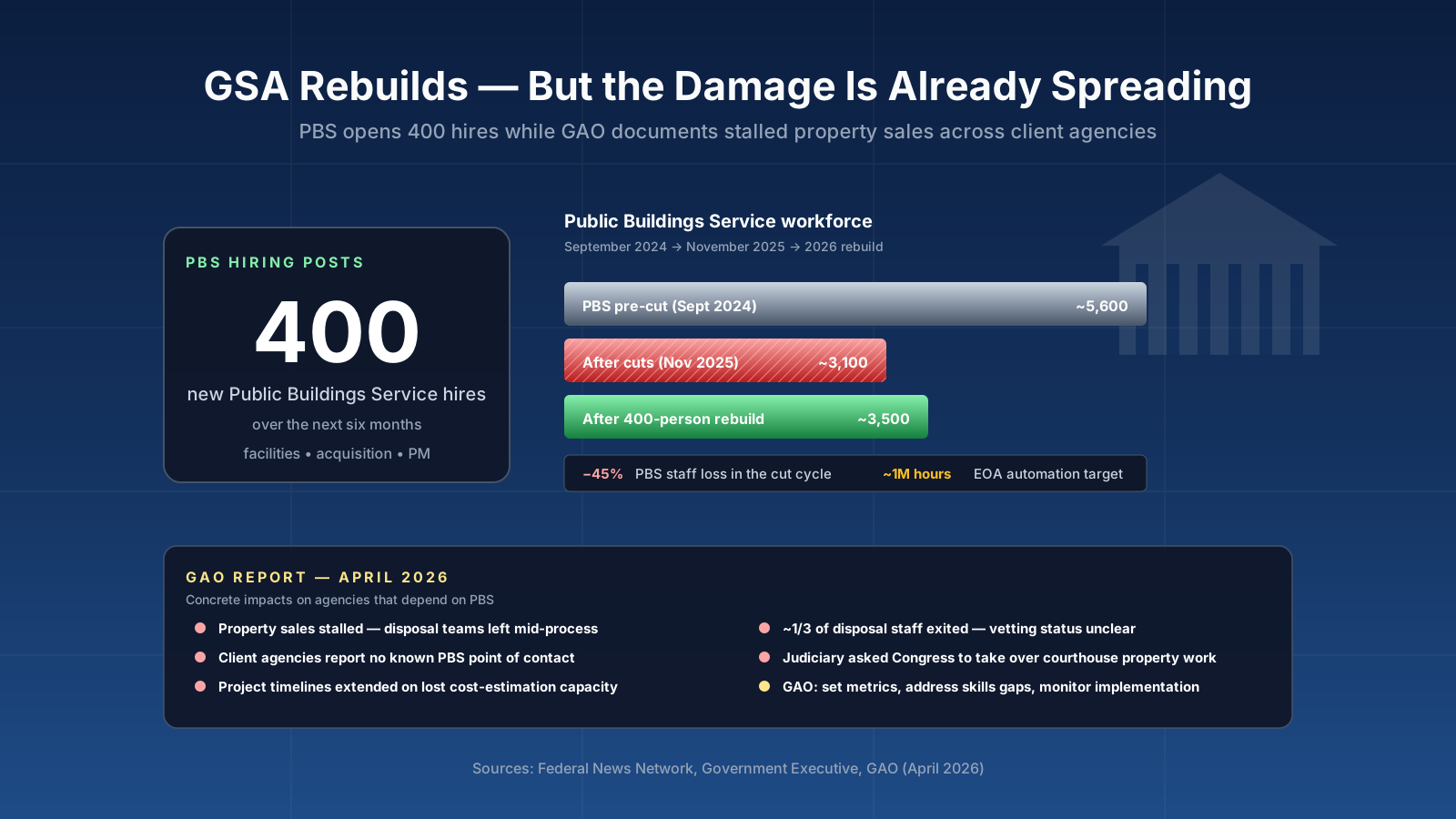
GSA's Rebuild: Hiring Back 400 in Public Buildings While the Watchdog Says the 45% Cut Is Already Hitting Other Agencies
The General Services Administration is opening roughly 400 Public Buildings Service hires over the next six months — the agency's first material rebuild after a year that took nearly 40 percent of its total workforce and 45 percent of PBS itself. The reopening lands in the same week a new Government Accountability Office report concluded that the cuts have already created stalled property sales, missing points of contact, and skills gaps that are disrupting client agencies across government. For the displaced GSA cohort that hit the private market in 2025, and for the contractors and consultants picking up the workload the agency can no longer carry, the rebuild signals where the seats are reopening and where the work has migrated for good.
What the Rebuild Actually Looks Like
According to Federal News Network's reporting, PBS Chief of Staff Donna Dix told staff in a March 30 internal email that the division is looking to hire about 400 employees over the next six months. The initial push concentrates on the three areas the agency now describes as its largest capacity gaps: facilities management, acquisition, and project management. PBS, which entered the cut cycle with more than 5,600 employees, ended 2025 at roughly 3,100. The 400-person rebuild does not get the division back to where it was — it gets the most exposed functions back to a workable floor.
The hiring announcement comes paired with a parallel push the agency has been describing internally as the “EOA” playbook — eliminate, optimize, automate. Federal News Network reported separately that GSA is targeting roughly one million work hours in automation over the coming year, with the explicit framing that the agency does not intend to staff back to its prior headcount. Rebuilding the seats that have to be human, automating the seats that can be code, and walking away from work that the cuts already eliminated is the formal posture.
The same reporting captured a less formal piece of the new posture: PBS is asking remaining employees to file daily status updates on their physical whereabouts. The agency tried to automate occupancy collection earlier in the spring; staff told Federal News Network the automated method did not produce the data leadership wanted, so the manual reporting requirement returned. Whatever the optics, the practical effect is that the rebuild is running alongside an in-office surveillance regime that has not gone over well with the staff who survived the cuts.
What the Watchdog Found
The rebuild announcement is harder to read in isolation than alongside the new GAO findings. Government Executive's coverage of the watchdog report documents PBS losing 45 percent of its employees between September 2024 and November 2025, with concrete operational consequences spreading to client agencies across the executive branch. One agency told GAO its employees no longer know who their PBS point of contact is. Another said it has had to extend project timelines because the staff who write cost estimates before a building can be offloaded are no longer in place. A property sale stalled because the team managing the sale left GSA, and the remaining staff were unsure if the steps to relocate the agency tenant had been completed — forcing GSA to restart the disposal process.
About a third of the staff responsible for processing disposals of GSA-owned properties left the agency in the cut cycle, GAO reported, “creating uncertainty on whether properties were properly vetted and approved to begin the process.” The watchdog recommended GSA set performance metrics for the reorganization, continuously solicit and incorporate stakeholder feedback, monitor implementation, and address PBS skills gaps directly. Those four recommendations are roughly the work the 400-person rebuild and the EOA push are now framed as answering — though the GAO report is explicit that the damage has already migrated past GSA's perimeter into the agencies it serves.
The HQ Consolidation, in the Same Cycle
The rebuild is unfolding alongside a separate but related move: GSA and OPM are consolidating into the same headquarters footprint. Government Executive and Federal News Network both reported on the headquarters merger as part of the broader push to shrink federal office space. For PBS, the consolidation is operationally consistent with the EOA framing: the same division that is hiring 400 people back to handle property sales and tenant relocations is the one being asked to execute the federal real estate footprint reduction. The two storylines pull on the same staff. Whether the rebuild is large enough to do both jobs at once is the open question the GAO report does not yet answer.
What It Means for Displaced GSA Staff
For the GSA cohort displaced in 2025, the rebuild is the clearest indicator yet of which functions are coming back inside the agency and which are gone for good. The reopening priorities — facilities management, acquisition, and project management — are the same skill families the GAO report flagged as the largest current gaps. Former PBS contracting officers, project managers on building disposals, and property-management specialists are sitting on exactly the experience PBS now says it cannot run without. For employees who left under the deferred-resignation program or the 2025 RIFs, this is a narrow but real reopening, and the hiring posts will move through USAJobs over the spring and summer. Anyone whose SF-50 reads PBS, regional facility services, or contracting in the 1102 series should be watching the May postings carefully.
The other side of the rebuild is the work the agency has decided not to bring back. The EOA framing is explicit that automation absorbs a meaningful share of the prior headcount — roughly a million hours of it. Roles that lived primarily in routine data extraction, occupancy reporting, and standardized acquisition packaging are not coming back as full-time seats, and former employees whose federal experience sat in those niches will have an easier conversation with private-sector employers than with a returning federal hiring board. The displaced cohort divides cleanly: project managers and acquisition specialists with specific PBS subject-matter expertise have a federal door reopening, while back-office support staff have a private-sector door that is more open than the federal one.
What It Means for Contractors and Employers
For government contractors, the GAO findings are also a market signal. The agencies whose property disposals are stuck waiting on PBS still have to relocate tenants, dispose of buildings, and stand up replacement leases. Some of that work is already migrating to in-house teams at client agencies — the federal judiciary publicly asked Congress for control over its own courthouse property management earlier this year, citing the GSA cuts directly. Contractors that already hold GSA Schedule property-management or facilities-engineering contract vehicles are well positioned to absorb the pieces of the workload the rebuild cannot reach this year, particularly real estate advisory, building condition assessment, and disposal-readiness consulting.
For private-sector employers recruiting from the displaced PBS cohort, the unusual feature of this group is the depth of federal real estate experience concentrated in a small population. PBS officers and senior project managers manage portfolios that, by square footage and tenant count, exceed most commercial real estate firms in the country. The candidates entering the market in 2026 from this division have run multi-region property portfolios, negotiated with cabinet-level tenants, and shepherded disposal transactions through the federal review chain. That is a translatable resume into commercial REITs, real estate private equity, large facility-services firms, and any private operator whose customers include federal lessees.
The Bigger Picture
The GSA rebuild is the second concrete “boomerang” story of the spring — HHS announced 12,000 hires in late April after cutting 20,000 the year prior — and the pattern is clarifying. The cut cycle ran ahead of the operating model that was supposed to absorb it, the watchdog reports are now arriving with concrete impact data, and individual agencies are hiring back the seats they cannot fully automate while letting the remainder migrate to contractors or to permanent elimination. For the HireFiredFeds audience, the operational read is straightforward: the doors the cuts closed in 2025 are partially reopening in 2026, but they are not reopening evenly. Federal real estate, facilities management, contracting, and project management are reopening; routine processing and back-office support are not. Track the posting cycle, translate the federal title into commercial language for the seats that are not coming back, and protect the credentials and clearances that built the career in the first place. The rebuild is real. So is the share of the work that is gone for good.
PBS Alum or Federal Real Estate Pro Looking for the Next Seat?
Build your profile on HireFiredFeds and connect with employers who value federal experience.