Hurricane Season Forces a Reversal: FEMA Reinstates 14 Whistleblowers and Rehires 100+ CORE Responders With June Deadlines Looming
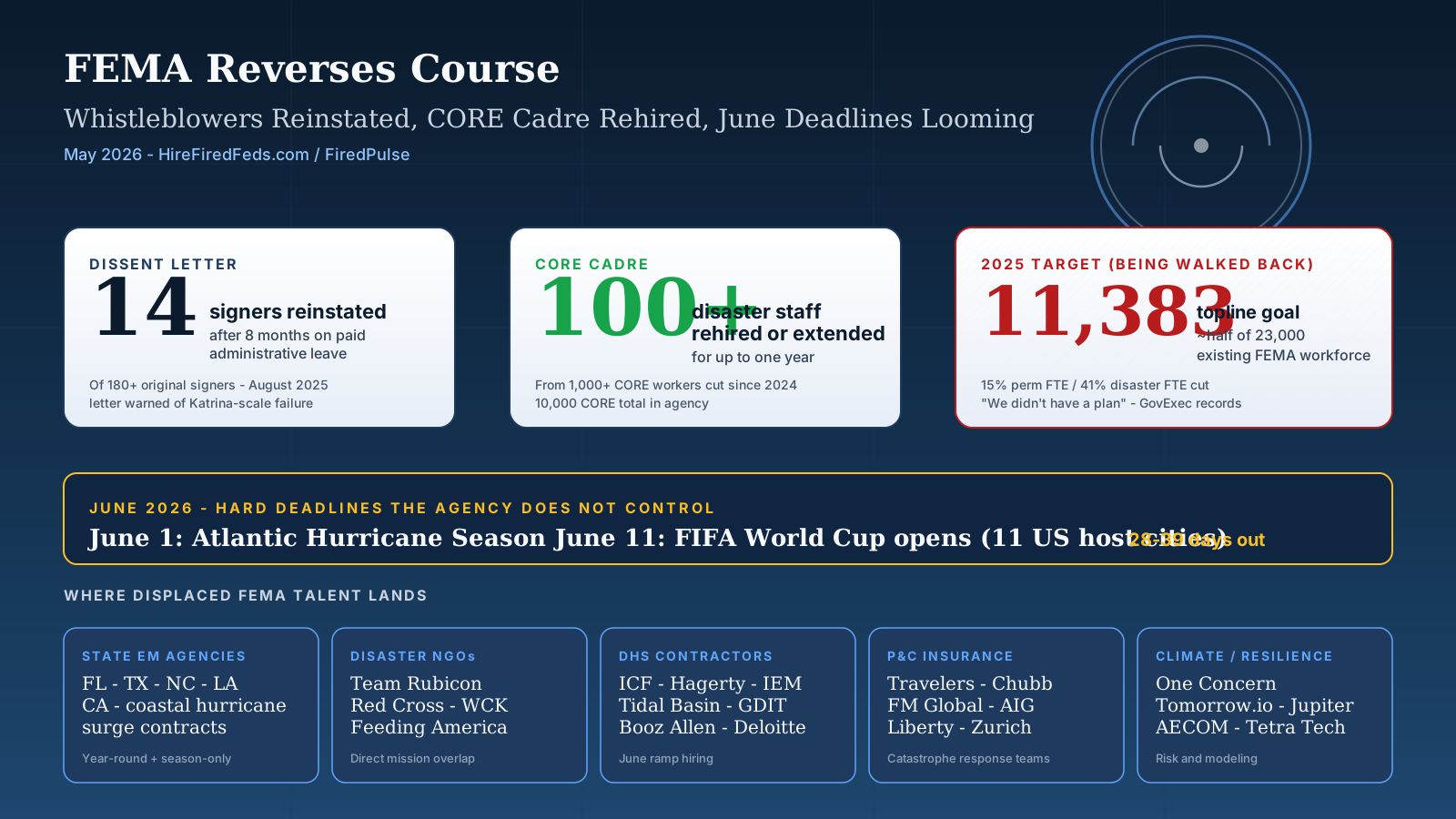
Two FEMA workforce stories landed inside one week and they tell the same story from opposite ends. On Wednesday the agency emailed fourteen employees who had been on paid administrative leave for eight months — every one of them a signer of the August 2025 open dissent letter that warned of a Katrina-scale failure — to tell them the investigation was closed and to report back to work the next day. A few days earlier, the agency confirmed it is moving to rehire more than one hundred CORE disaster responders whose contracts it had declined to renew over the winter, plus extending the people whose contracts expire next. The reversal is being executed against two hard deadlines neither side controls: the Atlantic hurricane season opens June 1, and the FIFA World Cup opens June 11 in the United States. An agency that spent the winter trying to engineer its way to roughly half its current size is now publicly walking the cuts back, one cohort at a time, because the calendar is no longer negotiable.
What Reversed This Week
Federal News Network reported on Friday that the fourteen FEMA employees who were suspended after publicly signing the August 2025 dissent letter were notified by email on Wednesday that the agency's internal investigation had been closed and that they were to return to work on Thursday. The dissent letter itself, sent to members of Congress and other officials, was signed by more than 180 FEMA staff and warned that the direction set by the new political leadership at FEMA and DHS — particularly the inexperience of the senior team — risked an operational failure on the order of Hurricane Katrina. Of the 180 signers, fourteen were placed on indefinite paid administrative leave; the rest remained on the rolls but with the same chilling effect.
Separately, The Washington Post reported on April 30 that FEMA is moving to rehire most of the disaster-response employees the agency dropped earlier in the year by declining to renew their term contracts. The targeted population is the Cadre of On-Call Response and Recovery, the CORE workforce. CORE employees with contracts ending between January and May who had previously been extended for ninety days are being told they may be reappointed for up to one year, and CORE employees whose contracts expire after May are being similarly offered extensions. CORE is not a small program: about ten thousand employees on FEMA's books fall under that designation, and the agency has cut more than a thousand of them since 2024. The May reappointments do not unwind the entire reduction, but they target the operational layer that runs joint field offices and disaster recovery centers when an event hits.
Both reversals are happening against the backdrop of the Trump administration's decision to nominate Cameron Hamilton to formally lead FEMA. Hamilton, a former acting administrator, was ousted in May 2025 a day after he testified to House appropriators that he did not believe FEMA should be eliminated; the planned re-nomination announcement, first reported in mid-April 2026, is being read inside the agency as a softening of the administration's public posture toward the agency's long-term existence. Senior official Karen Evans is still performing the duties of the administrator while the nomination moves through.
The Half-the-Agency Goal That Shaped the Year
The reversal has a particular shape because the cuts that produced it had a particular shape. Government Executive's April reporting on FEMA records documented that the agency landed on a topline target of roughly 11,383 employees — about half of the existing workforce of 23,000 — before any operational analysis of how to reach that number was performed. Internal records showed the leadership team setting the destination first and asking subordinates to back out a plan that would get them there. The target broke down to roughly a fifteen percent cut to the permanent full-time workforce and a forty-one percent cut to the disaster full-time workforce, which is where CORE sits.
That target sat under the FEMA Review Council that DHS Secretary Kristi Noem and Defense Secretary Pete Hegseth co-chair, and which has been working through reform recommendations since 2025. Court filings in the AFGE-led lawsuit challenging the cuts — brought as the agency was non-renewing CORE contracts in batches — produced testimony from former and current FEMA leaders warning that disaster response was at material risk if the cuts proceeded on schedule. Government Executive's February coverage captured the unusual on-the-record disagreement between former administrators and the current senior team. The reversals this week and last are not formally tied to that litigation, but they are the first concrete signs that the half-the-agency number is no longer driving operational decisions.
June 1 and June 11 Are the Forcing Functions
Two June dates are doing most of the work. The Atlantic hurricane season opens June 1, and FEMA's pre-positioning, joint field office staffing, and federal coordinator assignments for the season are normally locked in by mid-May. The FIFA World Cup opens June 11 with matches in eleven United States host cities, which puts FEMA into a planning posture it does not normally hold for a sustained civilian event — mass-gathering security, crowd-medical surge, and weather-event contingency for a multi-week sports calendar that overlaps directly with the early hurricane window. Both deadlines require trained, badged, and deployable personnel who already know FEMA's incident command and CORE operating model, and there is no efficient way to surge that personnel without bringing back the people the agency was already paying eight months ago.
The reinstatement notice to the dissent-letter signers is more than a personnel decision in that context. The letter signers were senior emergency management specialists, mitigation analysts, and program staff — the kind of mid-career federal professionals whose absence shows up immediately when a Joint Field Office stands up. Bringing them back ahead of the season also reduces the political exposure of going into hurricane season with Katrina-quoted whistleblowers still on paid leave, an optics problem the agency has been wearing since August.
What This Means for the Displaced Cohort
The reversal does not undo the year. More than a thousand CORE employees were dropped between 2024 and early 2026; not all of them are coming back. Permanent full-time staff who took deferred resignation, retired, or were RIF-ed earlier in the cycle are not being recalled. The May-and-later CORE reappointments target a defined slice of the workforce — the contract-expiring cohort in the disaster operations track — and even within that slice, not every offer will be accepted by people who have spent the past six months building outside options. For displaced FEMA staff who do not get a recall offer, or who do not want one, the destinations are the ones the disaster-response market has always pointed toward, and several of them are actively hiring against the same June deadlines.
State emergency management agencies are the most direct fit. Florida, Texas, North Carolina, Louisiana, and California run year-round emergency management operations large enough to absorb experienced federal hires; smaller coastal states have hurricane-season staffing surges that consume FEMA-type talent on a contract basis. The major disaster-response NGOs — Team Rubicon, the American Red Cross, World Central Kitchen, Feeding America, All Hands and Hearts — are operationally adjacent to FEMA's mission and have spent the past year hiring directly out of the federal pipeline; Team Rubicon in particular has visibly built a recruiting pathway for displaced federal disaster staff. The DHS contractors that hold large FEMA technical assistance and emergency-management support contracts — ICF International, Hagerty Consulting, IEM, Tidal Basin, CSRA, GDIT, Booz Allen Hamilton, Deloitte's public sector practice, and Accenture Federal Services — are recruiting for the same June ramp.
Two adjacent destinations are less obvious but increasingly real. The private property and commercial insurance industry has been building in-house disaster-response and resilience teams for several years; reinsurers and the property carriers (Travelers, Chubb, FM Global, Liberty Mutual, AIG, Zurich) hire former FEMA staff into catastrophe response, claims surge, and public-affairs liaison roles. And the climate analytics and risk-modeling space — One Concern, Tomorrow.io, Jupiter Intelligence, Climavision, and the resilience practices at the major engineering firms (AECOM, Tetra Tech, Stantec, ICF) — values FEMA hazard mitigation and risk-assessment veterans for product and field work. For CORE staff specifically, the pipeline into state-level disaster recovery contractors and into FEMA-funded mitigation work at the local government level remains the most natural landing.
The Bigger Picture
FEMA is the second federal agency in two weeks — HHS being the first, with the 12,000-hire announcement covered earlier on this site — to publicly reverse a major piece of its 2025 workforce reduction. The pattern is becoming visible: agencies that run operations with hard external deadlines and visible failure modes are pulling people back, and the agencies whose work is internal, analytical, or oversight-coded are not. FEMA cannot brown out a hurricane season the way Treasury can let an oversight office shrink. The half-the-agency number is being walked back not by a memo but by the operational layer of the agency hiring people back at month-by-month speed because June is fixed. For the broader displaced-fed cohort, the lesson is the same one this site has been writing: the work that produces measurable, time-pressured outcomes — disaster response, public health, tax administration, benefits delivery — is the work that gets reversed first when reality intrudes. The cohort that left FEMA in 2024 and the first half of 2025 is now competing with itself for slots in an agency that is publicly hiring. The window to come back, or to translate FEMA experience into a state, NGO, or contractor seat, is open right now and the deadline is the one Atlantic and FIFA already set.
FEMA Alum or Disaster-Response Pro Looking for the Next Seat?
Build your profile on HireFiredFeds and connect with state agencies, NGOs, contractors, and private-sector resilience teams that value federal emergency-management experience.