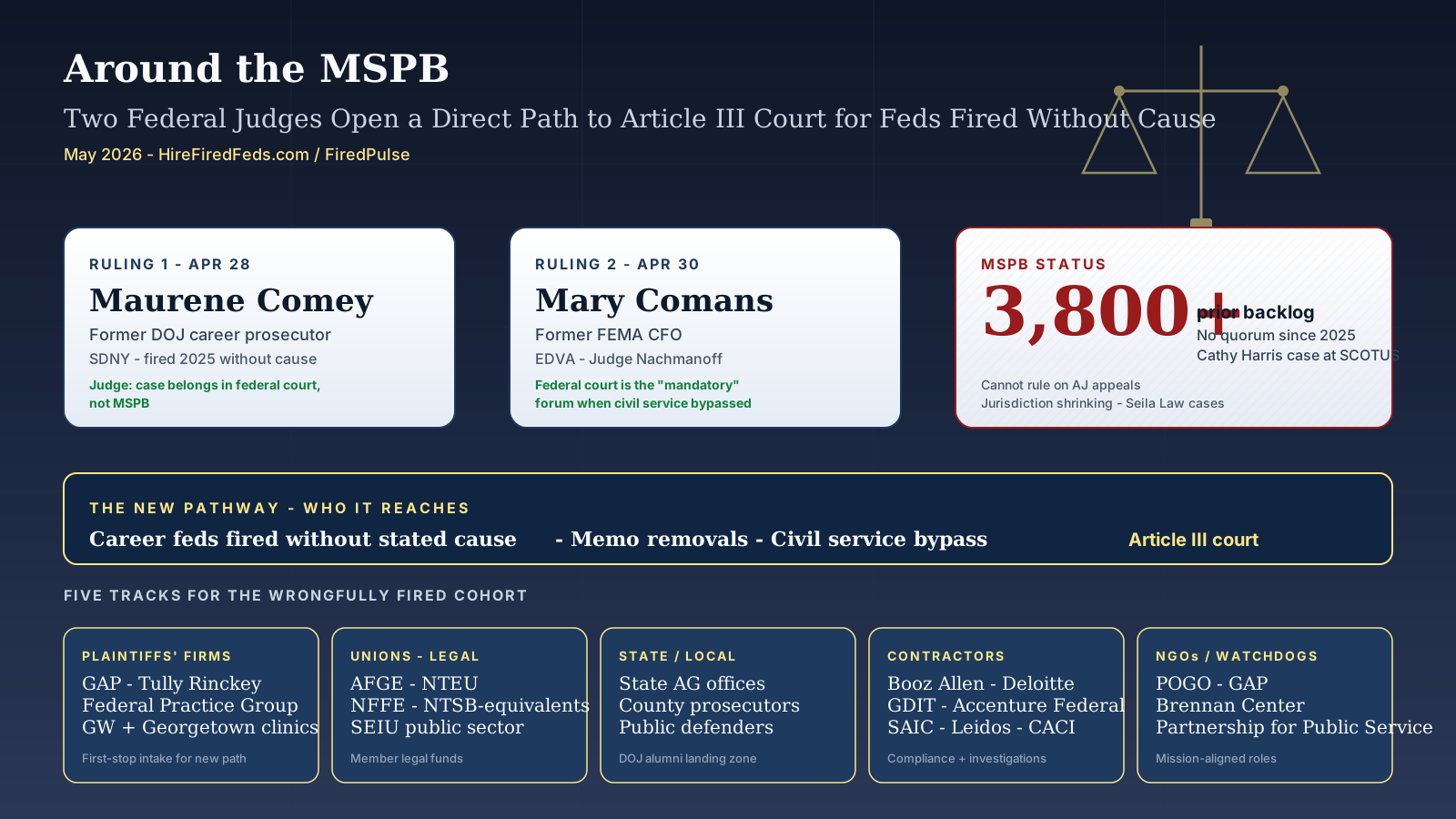
Around the MSPB: Two Federal Judges Open a Direct Path to Federal Court for Feds Fired Without Cause
In the last week of April 2026, two federal district court judges in separate cases ruled that career federal employees fired without stated cause can challenge those terminations directly in federal court — without first running the gauntlet of the Merit Systems Protection Board, the civil-service appeals body that was designed for exactly this purpose but that has spent most of the year operating without a quorum and with a shrinking jurisdictional footprint. The plaintiffs are former career Justice Department prosecutor Maurene Comey and former FEMA chief financial officer Mary Comans. Their cases are different in nearly every detail except the one that matters: in both, the agency reached around the Civil Service Reform Act's adverse-action procedures to fire a career employee, and in both, a federal judge said the right venue for the challenge is federal court rather than the administrative track. Read together, the rulings give the thousands of career feds fired without cause over the past year a second front to fight from.
The Two Cases
Government Executive reported that on April 28, 2026, a federal judge ruled that Maurene Comey's wrongful-termination case belongs in federal court, denying the government's motion to push the case into administrative proceedings. Comey, a longtime career prosecutor in the Justice Department's Southern District of New York and the daughter of former FBI director James Comey, was fired in 2025 without a stated cause; the Justice Department later argued that her removal was protected by the president's constitutional authority over executive officers and that any challenge belonged at MSPB or, after exhaustion there, the Federal Circuit. The district court rejected that argument as a matter of forum: where an agency does not invoke statutory civil-service grounds, the statute's exclusive-review channel does not engage, and the case stays in district court. The Washington Post covered the same decision the day it issued.
Two days later, in the Eastern District of Virginia, District Judge Michael Nachmanoff reached the same conclusion in the case brought by Mary Comans, the former FEMA CFO who was fired after the administration alleged she had improperly authorized federal dollars used to house migrants in hotels. Nachmanoff's opinion went a step further than the Comey ruling: because FEMA had circumvented civil-service law in firing Comans rather than invoking it, MSPB — which only has jurisdiction over the categories of removal the statute defines — was not an appropriate forum, and the federal court was the “mandatory” one. Neither ruling is on the merits of the firings. The judges have not said either dismissal was unlawful; they have said the question of whether it was unlawful must be answered by an Article III court, not the Reagan-era administrative board the executive has spent the past year hollowing out.
Why MSPB Cannot Currently Bear the Load
The forum question matters because the alternative is broken. MSPB has been operating without a quorum for most of 2026 after the Supreme Court allowed the administration's firing of board member Cathy Harris to stand pending appeal; Government Executive has tracked the case as Harris's petition continues at the Supreme Court. Without a quorum, the central board cannot rule on appeals from its administrative judges — the same posture that produced a 3,800-case backlog during the first Trump administration that took roughly three years to clear after a quorum was restored. The board's recent decisions have also narrowed the universe of cases it will hear at all, including a March 2026 ruling that immigration judges fired by the attorney general fall outside the board's jurisdiction because they are “inferior officers” under Seila Law.
The proposed regulatory changes layered on top of those cases compound the problem. OPM's March 2026 proposed RIF rule rewrites the order of retention factors to emphasize the most recent three performance appraisals over tenure, while the Schedule Policy/Career final rule moves an estimated 50,000 career feds in “policy-influencing” positions out of the standard adverse-action process altogether and removes their right to appeal a removal or a reclassification. Each piece of that stack assumes MSPB is the gate. The Comey and Comans rulings say it is not the only one.
The Counter-Pressure From the Other Direction
The new path is not unobstructed. The MSPB itself, in a March 20 decision in the case of fired immigration judges Megan Jackler and Brandon Jaroch, reversed an administrative judge's initial ruling and held that the attorney general has constitutional Article II authority to remove immigration judges at will because they are “inferior officers” under Seila Law; Federal News Network covered the Senate Democrats' warning that the decision could ripple across thousands of federal employees. The fired judges' attorneys have petitioned the Federal Circuit for review. On a parallel track, the D.C. Circuit's 2-to-1 decision upholding the firing of MSPB member Cathy Harris pending appeal is now before the Supreme Court, and the outcome will determine whether MSPB regains a quorum. The Federal Circuit and the Supreme Court will both shape how durable the Comey-Comans pathway is over the next year. The current state of the law is that two district courts have opened the door; the appellate courts have not yet closed it.
What This Means for Displaced Feds
For career feds who were fired in 2025 or 2026 without a stated cause — not RIF'd, not voluntarily separated through the Deferred Resignation Program, not converted to Schedule Policy/Career and dismissed under that authority, but simply removed by memo — the rulings open a litigation track that did not look viable two months ago. The track is narrow. It is not available to employees fired through the formal adverse-action process even if they believe the process was flawed; for those workers, the Civil Service Reform Act's administrative track remains the exclusive route. It is also not a guarantee of reinstatement: the merits of the firings have not been adjudicated in either case, and the path through district court runs longer than a clean MSPB hearing would in a normally functioning system.
What it does provide is a forum that is currently functional, an Article III judge instead of an administrative judge whose decisions cannot be reviewed for lack of a board quorum, and the procedural tools that come with civil litigation — including discovery into the agency's rationale and decision-making process. For attorneys advising displaced feds, that combination changes the calculus on whether to file at all. Several plaintiffs' firms specializing in federal-sector employment work — the Government Accountability Project, the National Treasury Employees Union legal staff, the Federal Practice Group, Tully Rinckey, and the academic clinics at George Washington and Georgetown that have been representing fired feds pro bono — are publicly tracking the new pathway and will be the first stop for affected employees who want to assess fit.
The career calculus is the harder question. A federal court appeal can take a year or longer; reinstatement, if it comes, may arrive after the displaced employee has already restarted somewhere else. The displaced cohort that has been moving into state government, federal contractors, mission-driven non-profits, and the private-sector public-sector practice areas over the past year is doing so on a faster clock than litigation runs on. The two paths are not mutually exclusive, and a number of the people most likely to prevail on a wrongful-termination claim are also the most marketable in the open market. For most of the cohort, the practical answer will be both: take the next seat now, and let the lawsuit resolve on its own timeline.
The Bigger Picture
The Civil Service Reform Act of 1978 was built on the premise that civil-service appeals would run through a specialized administrative body close to the workforce it served. That premise has been under steady pressure since the executive began removing board members and shrinking the universe of cases the board would hear. The Comey and Comans rulings are the first significant indication that the federal courts are willing to absorb the work the administrative system can no longer do, at least when the agency has reached around the statute rather than through it. The decisions do not solve the underlying problem — the appeals system is still working at a fraction of its designed capacity, and the regulatory and statutory pieces above it are still moving in the direction of fewer protections, not more — but they widen the field for the people most affected. For the federal workforce, May 2026 is shaping up to be a month where the courts, not the personnel offices, are the ones drawing the lines.
Career Fed Fired Without Cause? Looking for the Next Seat?
Build your profile on HireFiredFeds and connect with state agencies, NGOs, contractors, and private-sector employers who value federal experience and judgment.